
Level 2 · Lesson 5 of 4 · Know Your Game
Mini Baccarat vs Standard Baccarat: Same Game, Different Room

The layout differences
A standard baccarat table is kidney-shaped, seats up to fourteen players, and is staffed by three dealers. Two dealers sit on the house side and handle the chips. A third, the caller, stands opposite and manages the cards. The table is typically roped off, carries a minimum stake of $25 to $100, and sits in a slightly separated area of the casino floor, sometimes behind a screen or in a dedicated room.
At the Hippodrome Casino on Leicester Square, the Heliot Salon Privé runs standard Punto Banco in this format, with limits that go considerably higher for private arrangements. The room feels different from the main floor. Quieter. The felt is different. The ratio of staff to players is not what you'd find at a blackjack table.
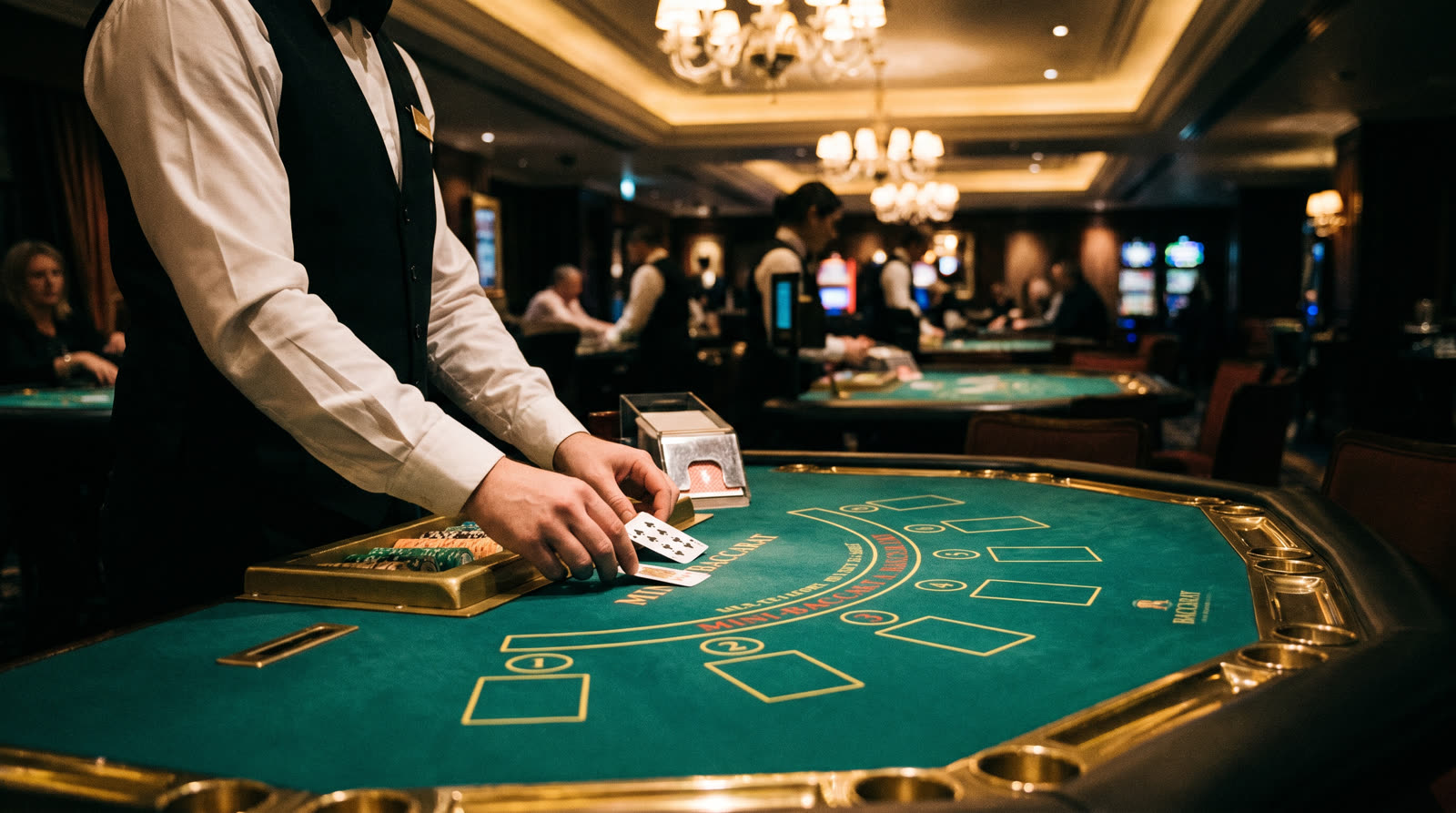
Mini baccarat uses a smaller, roughly blackjack-sized table. One dealer handles everything: dealing the cards, collecting losing bets, paying winning bets. It seats six or seven players. The minimum is lower, often £5 or £10, and it sits on the main casino floor rather than behind a velvet rope. Most electronic baccarat terminals at the Hippodrome and similar London rooms are effectively digital mini baccarat.
The rules inside both formats are identical. The third-card tableau is the same. The payouts are the same. The house edges are the same. You are playing the same game with a smaller table, a lower minimum, and one fewer dealer.
The pace difference is the thing that actually matters
I sat at the Empire Casino on Leicester Square for ninety minutes one Wednesday afternoon with nothing but a £25 minimum mini table for company. I counted 187 hands. That's the pace, and that's the budget.
This is the one genuinely important distinction, and most new players underestimate it.
At a standard table with twelve players, each of whom may want to squeeze the cards before the reveal, a shoe can take ninety minutes or more. The pace is ceremonial. Forty to seventy hands per hour is typical at a well-attended standard table.
Mini baccarat runs at roughly 150 to 200 hands per hour. The dealer controls the cards from start to finish, there's no squeezing, and the betting windows are short. Some electronic mini baccarat terminals run even faster.
The implication is straightforward: your expected loss per hour is the product of your average bet, the house edge, and the number of hands per hour. At 1.06% on Banker, betting $10 a hand at 200 hands per hour, you're exposing $2,000 to a 1.06% edge, giving an expected loss of roughly $21 per hour. At the same stake across a 50-hand-per-hour standard table, the same expected loss drops to about $5.30 per hour. The edge doesn't change. The volume does. And volume is what the casino manages.
Squeezing and ceremony
At standard tables in London and Macau, players are often handed the cards to reveal themselves. The squeeze is a controlled bend of the long edges that reveals the suit and value one pip at a time. The purpose is anticipation, not information. The player squeezing the cards cannot change what they are, and cannot see anything that changes the outcome. At the Wynn Macau VIP rooms this ritual is treated with enormous seriousness. Players sometimes curse or flick the cards after a bad reveal. Wynn Macau burns the shoe after each session specifically because the squeeze physically marks the cards.
The Hippodrome's floor doesn't allow squeezing on public tables because those cards are reused. The high-limit Heliot Salon Privé is a different matter. Mini baccarat deals face-up. The cards are turned without ceremony. If you're there for pace and low minimums, that's exactly right. If you're there for the theatre of high-limit baccarat, mini baccarat has none.
Which is better for a new player
The honest answer is: mini baccarat is better for learning the game if you're working with a modest budget, because the minimum stakes are lower and the pace lets you see many more outcomes per session. You will understand the rhythm of the shoe faster.
The drawback is that the same pace will eat your session budget faster than you might expect. A $50 buy-in at a $5 minimum mini baccarat table at 150 hands per hour will be gone in far less time than the same $50 at a $25 minimum standard table at 50 hands per hour. The UK Gambling Commission's responsible gambling guidance recommends setting a time limit as well as a monetary budget. At mini baccarat, a time limit is the more useful constraint.
Electronic baccarat terminals
A subset of both formats: many London venues, including the Hippodrome, run electronic baccarat terminals. These are individual screens where you bet digitally and watch a video feed of a live dealer turning real cards, or in some cases, a fully automated random number generator dealing virtual cards. The rules and edges are identical for the live-dealt version. RNG terminals are discussed in the next lesson. For the purposes of mini vs standard comparison, electronic terminals are effectively ultra-fast mini baccarat. The pace is even higher and the social element is minimal.
For players who want low minimums and no social pressure, electronic terminals are a practical option. You're playing the same game at the same edge. You're just not sitting at a live table.
The overseas comparison
Mini baccarat in its truest form is a North American invention. In Macau, the mass-market public floors at properties like the Venetian Macao run tables that look like standard baccarat in layout, staffed by a single dealer for speed, but with minimums typically in the range of HK$100 to HK$500. The high-limit VIP rooms at Wynn Macau start considerably higher. Crown Melbourne's Mahogany Room runs commission baccarat with table-service and minimum bets in the hundreds of Australian dollars.
In London, the distinction between mini and standard is less pronounced than in Las Vegas, but the pace differential remains. Any table with one dealer rather than three is running at a different speed, and that speed difference is the only thing that changes your expected losses per hour.
Key numbers
| Feature | Mini Baccarat | Standard Baccarat |
|---|---|---|
| Table size | Small (blackjack-sized) | Large, kidney-shaped |
| Seats | 6 to 7 | Up to 14 |
| Dealers | 1 | 3 |
| Typical minimum stake | $5 to $25 | $25 to $100+ |
| Hands per hour | 150 to 200 | 40 to 70 |
| Card squeezing | No | Often yes |
| House edge, Banker | 1.06% | 1.06% |
| House edge, Player | 1.24% | 1.24% |
| House edge, Tie | 14.36% | 14.36% |
Sources: Hippodrome Casino baccarat, Wynn Macau baccarat, UKGC safer gambling guidance.
Welcome to the lesson on mini baccarat versus standard baccarat.
I'm Annabel. This lesson is about format, not fundamentals. The rules of baccarat don't change between a mini table and a standard one. The house edges don't change. What changes is the room, the pace, and a couple of small details about the experience that matter more than most people expect.
Let me start with what actually is different.
A standard baccarat table is the big one. Kidney-shaped, seats up to fourteen players, staffed by three dealers. Two on the house side handling chips, one standing opposite managing the cards. The minimums tend to run from twenty-five to a hundred pounds, and the table usually sits in a slightly separate part of the casino floor. At the Hippodrome on Leicester Square, the Heliot Salon Privé runs this format. The room feels different. Quieter. More staff per player.
Mini baccarat is a smaller table, roughly the same size as a blackjack table. One dealer handles everything: dealing, collecting, paying. Seats six or seven players, minimums as low as five dollars, and it sits on the main casino floor without the rope and the ceremony.
The rules inside both are identical. Same third-card tableau. Same payouts. Same house edge of one point zero six percent on Banker, one point two four on Player, fourteen point three six on Tie.
So what's the actual difference? It's pace.
At a standard table with twelve players, some of whom will want to squeeze the cards before the reveal, you might see forty to seventy hands per hour. At mini baccarat, the dealer controls the cards from start to finish, there's no squeezing, and the betting windows are short. You're looking at a hundred and fifty to two hundred hands per hour.
That pace difference is the single most important thing to understand about mini baccarat. Your expected loss per hour is the product of your average bet, the house edge, and the number of hands you play. At one point zero six percent on Banker, betting ten dollars a hand, two hundred hands per hour means you're exposing two thousand dollars to the edge every hour. Expected hourly loss: about twenty-one dollars. At the same stake on a fifty-hand-per-hour standard table, that expected loss drops to about five dollars thirty. The edge hasn't changed. The volume has.
Now, squeezing. At standard tables in London and Macau, players are often handed the cards to reveal themselves. You bend the long edges slowly, revealing the suit and value one pip at a time. It doesn't change the cards. You can't see anything that would change the outcome. But at high-limit tables in Macau, like those at the Wynn Macau, this ceremony is treated with enormous seriousness. Players sometimes curse the cards, or flick them off the table after a bad reveal. The Wynn Macau burns every shoe because the squeeze marks the cards physically, which means they can't be reused. The Hippodrome's public tables don't allow squeezing for exactly that reason. Cards are reused across multiple shoes, so they stay pristine.
Mini baccarat deals face-up. Cards turned without ceremony. If you're there for pace and low minimums, that's exactly right. If you're there for the theatre of high-limit baccarat, mini gives you nothing.
So which should a new player choose? Mini baccarat is better for learning quickly, because the lower minimums and higher pace mean you see more outcomes in a shorter time. You understand the rhythm of the shoe faster. But the pace cuts both ways. A fifty-dollar buy-in at a five-dollar minimum mini table will be gone faster than you expect. Set a time limit, not just a budget limit.
Electronic baccarat terminals, which you'll find at the Hippodrome and similar London venues, are effectively ultra-fast mini baccarat. Rules and edges identical. The social element: minimal.
Here's what to take from this lesson. Mini baccarat and standard baccarat are the same game. The edge is the same. The decision is about pace and bankroll, not about odds. Mini runs two to four times as many hands per hour, so two to four times the hourly expected loss at the same stake. Standard baccarat costs more to sit at but runs more slowly, which is a genuine financial advantage if you're managing a session budget carefully.
At Marina Bay Sands in Singapore, the main baccarat pit runs what looks superficially like standard format but with a single dealer per table on the mass floor. I counted seventy-three hands in one hour. The high-limit room next door had three staff and dealt forty-one.
Here's one more observation from the casino floor that puts this in focus. At the Wynn Macau's main floor, the mass-market baccarat tables are staffed by a single dealer, turning cards at a rapid pace, with minimum bets well below what the VIP rooms require. The high-limit rooms one floor up run the same game at a fraction of the speed, with three staff at the table, card squeezing available, and minimums that make a fifty-pound buy-in look like the wrong currency. The edge is identical at both tables. The difference is entirely in pace, ceremony, and the amount of time it takes the edge to manifest in absolute dollars.
Know your pace. Know your budget. The maths does not change between the two formats.