
Level 4 · Lesson 13 of 4 · Strategic Thinking
Strategy in Baccarat: What You Control and What You Don't

Bet selection
Start here, because it's the only structural decision you make.
You choose Banker, Player, or Tie. Banker at 1.06% is the correct choice on every hand. Player at 1.24% is close enough that it's acceptable. Tie at 14.36% is not a strategic option. It is hope at a fourteen-times price premium.
Nothing else under bet selection matters. Not whether Banker has won six in a row. Not whether Player is "due." Not whether you have a feeling. The base rate of Banker winning any given hand is 45.86%, regardless of what the scoreboard shows. The Wynn Macau VIP regulars know this and bet the streaks anyway, because it's part of the ritual, not because they believe it changes anything.
If you're going to bet anything other than Banker in standard Punto Banco, bet Player. Never Tie. Never the side bets unless you've consciously decided to pay the extra edge for entertainment value.
Stake sizing
You decide how much to bet per hand. Higher stakes don't change the edge, but they change the absolute expected loss and the rate at which variance resolves.
At $100 per hand at a 1.06% Banker edge, you expect to lose $1.06 per hand. At $25 per hand, you expect to lose 26.5 cents per hand. The percentage is identical. The dollars differ.
Stake sizing also determines session duration. The Heliot Salon Prive at the Hippodrome on Leicester Square opens at £25 a hand. Two consecutive losses costs you £50. That's not the evening over. At a £500 loss limit, you have room for the variance to run. At £100 a hand, two bad runs and you're done inside twenty minutes.
Size your stake relative to your session budget, not relative to what you want to win. A stake of 1% to 2% of your session bankroll gives the edge room to work against you for a while before you hit your limit.
What the road maps actually tell you
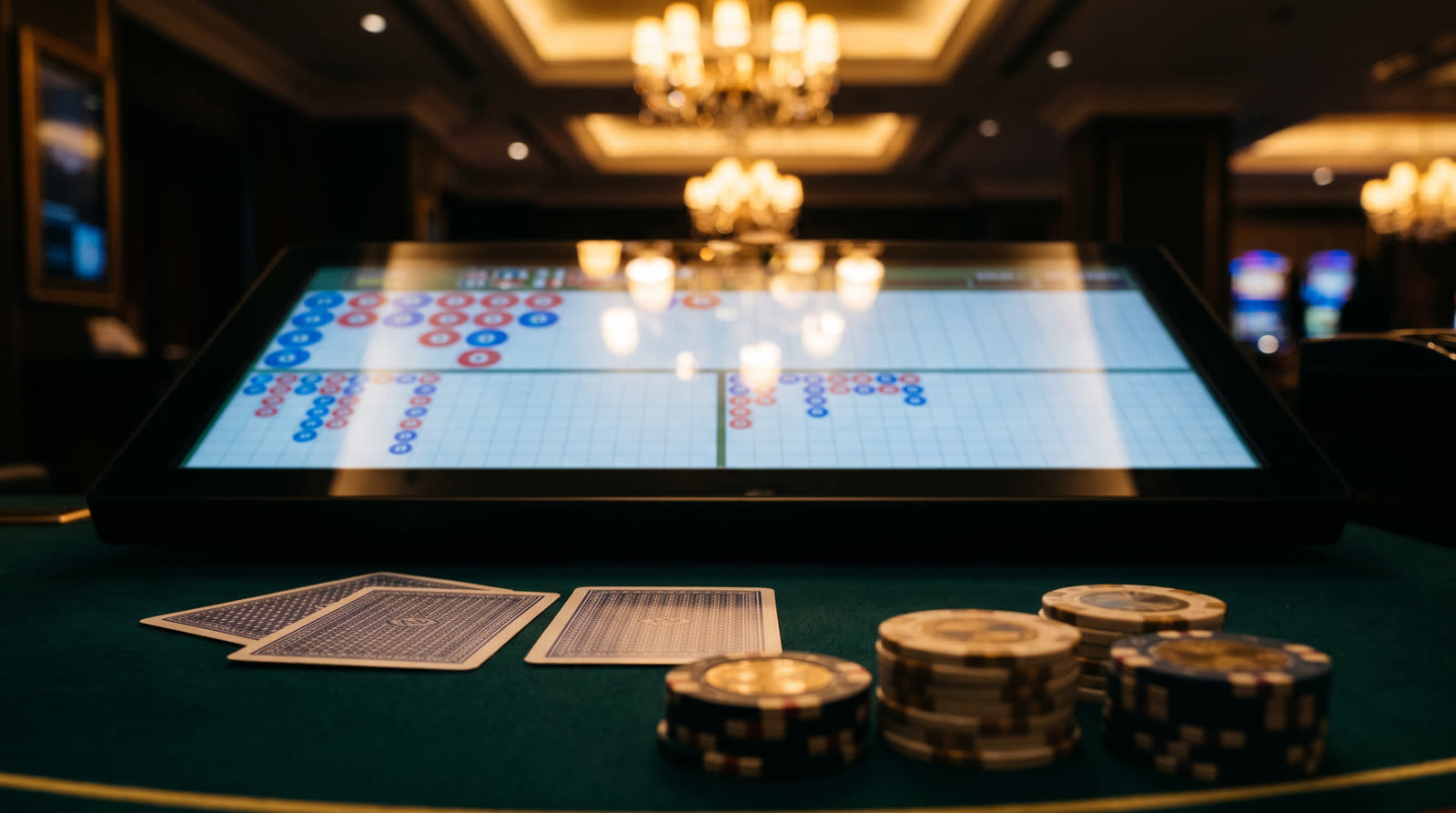
Every live baccarat table runs a scoreboard: the Bead Road, the Big Road, the Big Eye Boy, the Small Road, the Cockroach Road. Five different compressions of the same historical data.
The Bead Road shows you every hand result since the shoe started. The Big Road groups results into streaks. The Big Eye Boy, Small Road, and Cockroach Road derive patterns from the Big Road itself, not from the cards.
They are excellent for reading what just happened.
They have zero predictive value for what happens next.
The shoe doesn't remember what it dealt. The next hand's probability is fixed by the composition of remaining cards in the shoe, not by the pattern on the screen. The Casino di Venezia has been running baccarat since 1638. The road map has never once predicted a hand, and the house edge has remained positive throughout.
Read the road maps to follow the game. Don't read them to bet.
I sat at the Casino di Venezia once and watched the electronic scoreboard cycle through a full shoe in the room adjacent to the Grand Canal. The Big Road showed a long Banker streak: nine consecutive. The player next to me switched to Player on hand ten, citing the streak. Banker won hand ten as well. He switched back. None of it mattered. The shoe doesn't know it's in Venice.
What strategy can't do
No staking pattern moves the edge. Martingale, Fibonacci, the d'Alembert, the Paroli, the Labouchere: the Banker bet pays 0.95 to 1 after commission and the draw rules are fixed. You can lose ten in a row on Banker just as easily as on a coin flip with a slight bias. The Hippodrome's high-limit room has watched it happen at thirty grand a hand.
No road-map pattern predicts the next hand. All five road maps compress the same data into different shapes. They are excellent for reading what just happened. They have zero predictive value.
No system beats baccarat. If one did, the Salons Privés at the Casino de Monte-Carlo would have closed in 1865.
Session management
This is the most important strategic variable and the one most players don't treat as strategy.
Set a loss limit before you sit down. It should be the amount you're genuinely prepared to lose: not the amount you'll reluctantly accept losing, the amount you're comfortable with. Set a time limit. An hour, two hours, whatever fits your evening. And optionally, set a win target: a point at which you'll stop if you're ahead, because nobody ever lost money by leaving a session in profit.
Then keep those decisions. Not "keep them unless I'm on a run." Keep them.
The UKGC's safer gambling guidance frames pre-commitment tools as the core practical mechanism for managing gambling spend. They're right. In baccarat specifically, you can't outplay the edge on the hands. The session decisions are the only place where discipline has real value.
The honest expected cost
That is the honest cost of the game correctly played. Two hours of baccarat at a London table, minimum stake, expected outcome: roughly thirty-four pounds. If you're hitting that estimate and leaving, you've played well. If you're still there at hour four having chased down to find your system's flaw, you haven't.
At Les Ambassadeurs, where the minimum is significantly higher, the same arithmetic applies at a larger scale. The percentage is fixed. The dollars change. At the Bellagio Salon Prive in Las Vegas, where minimums start at $500, a two-hour session at flat stakes costs an expected $690 in edge. Every room, every limit. The strategy is still the session.
The strategy is the session. Not the hand.
Key numbers
| Strategic variable | Player controls it | Affects house edge |
|---|---|---|
| Bet selection (Banker/Player/Tie) | Yes | Yes: Banker = 1.06%, Player = 1.24%, Tie = 14.36% |
| Stake size | Yes | No: absolute loss scales, percentage doesn't |
| Side bet placement | Yes | Yes: all side bets worse than Banker |
| Session loss limit | Yes | No: limits exposure, not edge |
| Road map pattern following | Yes | No: zero effect on outcomes |
| Betting system | Yes | No: zero effect on edge |
Sources: Eliot Jacobson on baccarat edge, UKGC safer gambling, Hippodrome baccarat, Casino di Venezia history.
Welcome to the lesson on strategy in baccarat.
I'm Annabel, and this lesson is the honest one. There's a lot written about baccarat strategy. Most of it is embroidery on a very simple point, or it's wrong. I want to give you a precise account of what player strategy actually controls, and what it doesn't.
Start with the structural fact that governs everything else.
Baccarat has no in-hand strategic decisions. Once you've placed your bet, the rules play out mechanically. The drawing tableau is fixed. You cannot hit, stand, double, or fold. You cannot look at the cards and decide whether to draw. The rules decide that. You watch.
So strategy in baccarat is three things.
Bet selection. This is the only structural strategic decision in the game. You choose Banker, Player, or Tie. Banker at one point zero six percent is correct. Player at one point two four percent is acceptable. Tie at fourteen point three six percent is not a strategic option. It is hope at a fourteen-times price premium.
No other bet selection logic changes the edge. Betting Banker when it's "due," switching to Player after a six-hand Banker streak, alternating bets based on a pattern you think you've spotted: none of it moves the probability on the next hand. The Wynn Macau VIP regulars bet the streaks anyway, because it's part of the ritual of the room. Not because it changes anything.
Stake sizing. You decide how much to bet per hand. Higher stakes don't change the edge, but they change the absolute expected loss and how quickly variance resolves. At one hundred dollars per hand at one point zero six percent, you expect to lose one dollar six cents per hand. At twenty-five dollars per hand, twenty-six and a half cents. The percentage is identical. The dollars differ.
The Heliot Salon Prive at the Hippodrome on Leicester Square opens at twenty-five pounds a hand. Two consecutive losses costs you fifty pounds. At a five-hundred-pound loss limit, that's manageable. At a hundred pounds a hand with the same limit, two bad runs and you're done inside twenty minutes. Size your stake relative to your budget. Not relative to what you want to win.
Session management. This is the most important variable and the one most players don't treat as strategy.
Set a loss limit before you sit down. The amount you're genuinely prepared to lose, not the amount you'll reluctantly accept losing. Set a time limit. Set a win target if you want one: a point at which you'll stop if you're ahead. Then keep those decisions. Not "keep them unless I'm on a run." Keep them.
The UK Gambling Commission frames pre-commitment tools as the core practical mechanism for managing gambling expenditure. They're correct. In baccarat, you can't outplay the edge on the hands. The session decisions are the only place where discipline has real value.
I've made every variation of the session mistake at some point. Played past the time limit because I was "almost even." Raised my stake after a run of losses because I was convinced things were about to turn. Stayed at the Casino di Venezia for an extra hour because the room was beautiful and it seemed a shame to leave. None of it changed the 1.06%. The only thing that changes is how much of your bankroll you expose to it.
What strategy can't do
No staking pattern moves the edge. Martingale, Fibonacci, the d'Alembert, the Paroli, the Labouchere: the Banker bet pays zero point nine five to one after commission and the draw rules are fixed. You can lose ten in a row on Banker just as easily as on a coin flip with a slight bias. The Hippodrome's high-limit room has watched it happen at thirty grand a hand.
No road-map pattern predicts the next hand. The Bead Road, the Big Road, Big Eye Boy, the Small Road, the Cockroach Road: all five compress the same data into different shapes. They are excellent for reading what just happened. They have zero predictive value.
No system beats baccarat. If one did, the Salons Privés at the Casino de Monte-Carlo would have closed in eighteen sixty-five.
The honest expected cost of two hours at the Heliot, betting Banker at the twenty-five-pound minimum, sixty-five hands an hour: approximately thirty-four pounds forty-five. That is the correct price of the entertainment. If you walk out having spent around that, you played the game well.
Strategy in baccarat is not about the hand. It's about everything around it. Decide your bet, your stake, your limits. Then let the cards do what the cards do.
Here is the full picture in one paragraph. Bet Banker. Set a loss limit, a time limit, and if you want one, a win target. Size your stake relative to your budget, not relative to what you'd like to win. Leave the Tie and the side bets alone. Don't change your bet based on the road maps. Those decisions are the strategy. The hand plays itself.
At Les Ambassadeurs and at Wynn Macau, where the minimum bets run much higher than the Heliot, the arithmetic scales but the structure doesn't change. Larger absolute numbers, the same one point zero six percent, the same session decisions. More expensive, not more complicated.