
Level 5 · Lesson 20 of 4 · Advanced Player
Chemin de Fer, Baccarat Banque, and the Original Punto Banco

What Chemin de Fer is
Chemin de Fer is the version of baccarat that French aristocracy refined in the nineteenth century and carried into the earliest Monte Carlo rooms and British private clubs. The name is French for "railway" or "iron road," thought to refer to the card shoe sliding around the table from player to player.
The fundamental difference from Punto Banco: the bank is not the casino. The bank is a player. Players rotate as banker, or the bank can be auctioned to the highest bidder. The player-bank puts up a stake; other players bet against it up to the banker's total. If more players want to bet than the bank can cover, the excess falls away.
The casino takes a commission (typically 5%) on bank winnings. It bears no risk: it earns regardless of who wins each hand.
The one genuine decision
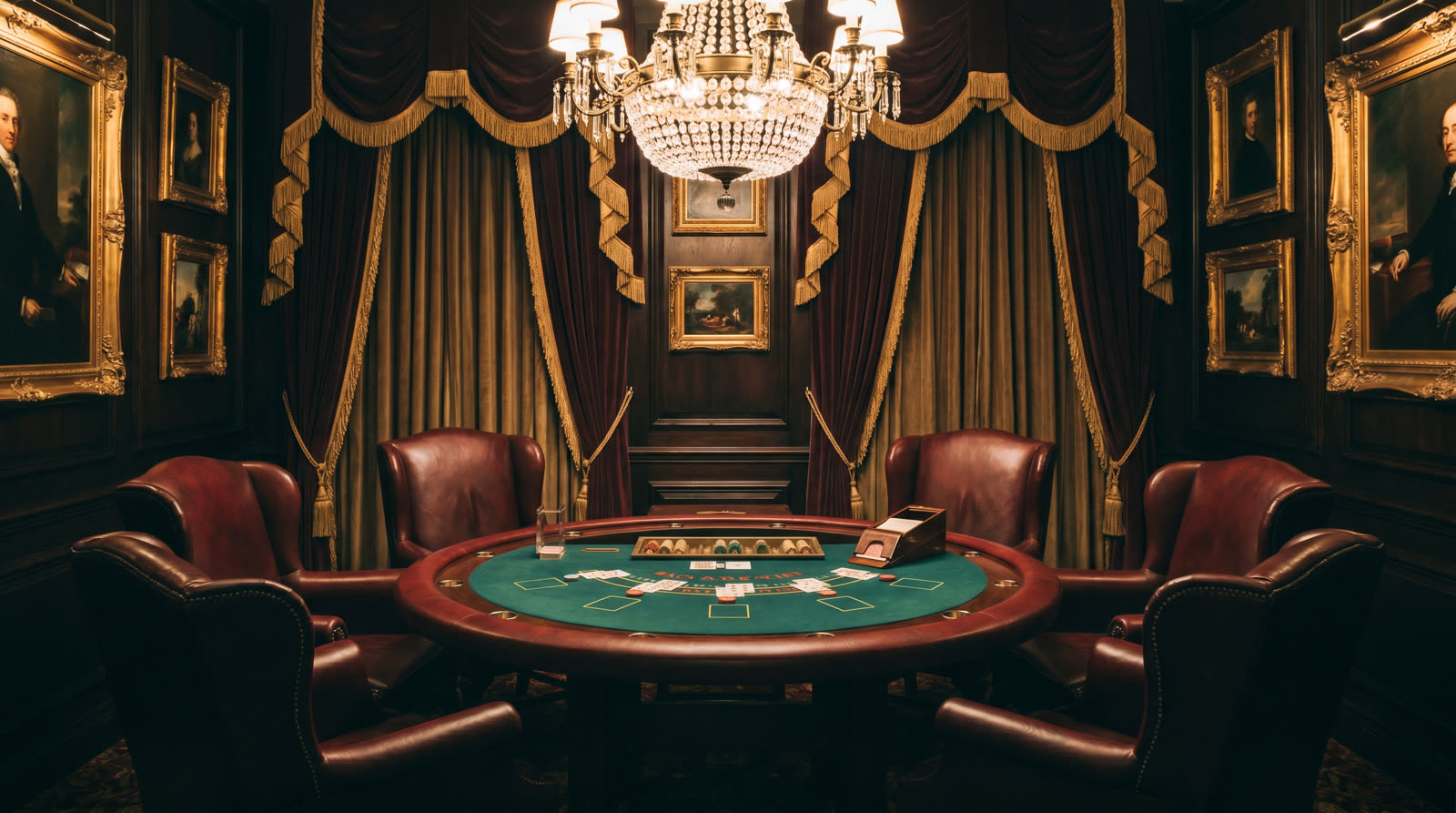
I went to a Chemin de Fer session at Les Ambassadeurs one Thursday evening specifically to watch the draw-on-5 decision rather than participate. The room is smaller than you'd expect from the address. Two tables, low light, no roadmaps. The draw-on-5 moments were the only ones where the pace changed. Everyone at the table understood what the decision meant. The social weight of it was unlike anything at a Punto Banco table. You could see the other players recalibrate their own positions each time someone decided.
Both the Player role and the Banker role have discretion on a two-card total of 5: draw or stand. All other totals are fixed. Zero through four draw; six and seven stand; eight and nine are naturals.
The optimal strategy for the 5-draw decision depends on the context of each hand. In practice, at Les Ambassadeurs and the Monte-Carlo Salons Prives, the social dynamics around this decision are part of the game's ceremony. Who hesitates, who draws quickly, what you signal to the room: all of this is present in a way that has no equivalent at a Punto Banco table.
That single decision, available to both sides on a total of 5, gives Chemin de Fer the modest strategic texture that Punto Banco deliberately removed.
Baccarat Banque
Baccarat Banque works similarly to Chemin de Fer but the bank stays fixed for the entire shoe, rather than rotating. The player holding the bank holds it until the shoe is exhausted or until the bank's stake runs out. The bank deals three hands: one to the right side of the table, one to the left, one for itself.
Even rarer than Chemin de Fer. Found in a handful of continental European casinos, occasionally in private high-limit rooms where a specific player wants to hold the bank for extended play. Not available at any London public casino.
The development of Punto Banco
Punto Banco was developed for the American and Cuban markets and brought to Las Vegas by Tommy Renzoni in 1959 at the Sands Casino. The format eliminated the player-bank rotation entirely. The casino holds the bank permanently. All decisions are codified into the fixed drawing tableau. The Player-role's decision on 5 disappeared. The Banker-role's decision on 5 disappeared. What remained was a game with zero in-hand decisions and a fixed, publicly knowable 1.06% house edge.
Macau adopted Punto Banco as its dominant format in the 1970s and 1980s. The Macau DICJ reports baccarat generating approximately 88% of gross gaming revenue: that figure reflects Punto Banco operating at enormous volume across hundreds of tables at the Venetian Macao, Galaxy Macau, and the other Cotai Strip properties. The player-bank rotation of Chemin de Fer would be impossible to run at that scale or speed.
The trade-off is explicit. Punto Banco lost the strategic texture. In exchange, it enabled volume. Both things are true.
Ian Fleming and Casino Royale
Fleming's first Bond novel, published in 1953, is structured around a high-stakes Chemin de Fer game at the fictional Royale-les-Eaux casino. Fleming was a member of Les Ambassadeurs Club in Mayfair and played regularly at clubs in France and Monte Carlo. His description of the game is technically accurate. Bond's decision on whether to draw on his 5 is the pivot of the central game: a real Chemin de Fer decision with genuine stakes.
Fleming's real-world inspiration for Royale-les-Eaux is disputed. Le Touquet, Royat-les-Bains, and the Casino Estoril in Lisbon (which Fleming visited during the war as an intelligence officer) are all cited as possible models. None is definitive. What's clear is that Fleming understood Chemin de Fer well enough to make it the architecture of a thriller. The Britannica entry on Casino Royale covers the novel's gaming context.
Visiting Chemin de Fer today
Les Ambassadeurs Club at 5 Hamilton Place, Mayfair, retains Chemin de Fer. It is a private members' club; joining requires an introduction and a membership fee. The Casino de Monte-Carlo offers it in the Salons Prives. These are the two practical addresses for live Chemin de Fer in a prestige room if you're based in or visiting either city.
I visited Casino Estoril in Lisbon on a research trip and walked the floor specifically to check whether Chemin de Fer was still on the card. It wasn't that day, but the staff confirmed it ran on request for organised parties. The building itself is extraordinary: a 1916 Art Deco casino that sat at the centre of wartime European intelligence operations and, if Fleming's own account is accurate, provided the mental architecture for Royale-les-Eaux. The Punto Banco tables in the main room felt almost incongruous against that history.
Beyond those, Casino Estoril in Portugal, on the Estoril coast outside Lisbon, has historical associations with baccarat that predate most European rooms, and still operates live table games. Ian Fleming visited during the Second World War as an intelligence officer; the Casino Estoril is one of the cited inspirations for Casino Royale's fictional Royale-les-Eaux.
The experience is materially different from Punto Banco. Smaller table, more ceremonial, and with the draw-on-5 decision that gives the game its texture. If you want to understand what baccarat was before the casinos industrialised it, Les Ambassadeurs is the place.
Key numbers
| Format | Bank held by | Player decisions | Location |
|---|---|---|---|
| Chemin de Fer | Rotating player | Draw on 5 (both sides) | Les Ambassadeurs, Casino de Monte-Carlo |
| Baccarat Banque | Fixed player (full shoe) | Draw on 5 (both sides) | Continental Europe |
| Punto Banco | Casino permanently | None | All London casinos, Macau, online |
Sources: Les Ambassadeurs Club, Casino de Monte-Carlo, Britannica on Casino Royale, Macau DICJ statistics, Casino Estoril.
Welcome to the lesson on Chemin de Fer, Baccarat Banque, and the original Punto Banco.
I'm Annabel. This lesson is about where baccarat came from before the casino industrialised it. If you've played standard Punto Banco, you've been playing the finished product. Chemin de Fer is the prototype. Understanding the relationship between the two tells you something about what was deliberately removed from the game and why.
Chemin de Fer. The name is French for "railway," likely a reference to the card shoe sliding around the table from player to player. This is the version that French aristocracy refined in the nineteenth century and that moved into the earliest Monte Carlo rooms and British private clubs. Ian Fleming used it in Casino Royale in nineteen fifty-three: Bond's high-stakes game at the fictional Royale-les-Eaux is Chemin de Fer.
The fundamental difference from Punto Banco: the bank is not the casino. The bank is a player. Players rotate as banker. The player-bank puts up a stake; other players bet against it up to the banker's total. The casino takes a commission on bank winnings and bears no risk. It earns regardless of who wins.
Here is the thing that makes Chemin de Fer different from everything else this school teaches.
Both the Player side and the Banker side have one genuine decision: whether to draw on a total of five. All other totals are fixed, exactly as in Punto Banco: zero through four draw, six and seven stand, eight and nine are naturals. The draw-on-five is a real decision with strategic implications, and at Les Ambassadeurs Club at five Hamilton Place in Mayfair, where Chemin de Fer still runs, the social dynamics around that decision are part of the game. Who hesitates. Who draws without pausing. What you signal to the room. None of that exists at a Punto Banco table.
Fleming understood this. Bond's decision on whether to draw on his five is the pivot of the central game in Casino Royale. That is a real Chemin de Fer decision with genuine stakes. Fleming was a member of Les Ambassadeurs Club and played regularly at clubs in France and at Monte Carlo. His description of the game is technically accurate.
I went to a Chemin de Fer session at Les Ambassadeurs one Thursday specifically to watch the draw-on-five decision rather than participate. The room is smaller than you'd expect from the address. Two tables, no roadmaps, low light. The draw-on-five was the only moment where the pace changed. Everyone at the table understood what was being weighed. You could see the other players adjusting their own positions as the decision was made. There's nothing like that moment in Punto Banco, because in Punto Banco the moment doesn't exist.
Baccarat Banque is a close relative. The bank is fixed for the entire shoe rather than rotating. The player holding the bank holds it until the shoe is exhausted or the bank's stake is gone. Rarer than Chemin de Fer. Found in a handful of continental European casinos. Not available at any London public casino.
Casino Estoril in Lisbon is one of the cited inspirations for Fleming's Royale-les-Eaux. I visited on a research trip specifically to see the room he would have known. The building is an Art Deco casino from nineteen sixteen that sat at the centre of wartime European intelligence during the Second World War. You walk in and understand immediately why it lodged in the imagination of someone like Fleming. The current main room runs Punto Banco, which feels almost anachronistic against the architecture. But the bones of the original room are there.
Punto Banco was developed for the American and Cuban markets and brought to Las Vegas by Tommy Renzoni in nineteen fifty-nine at the Sands Casino. The format eliminated the player-bank rotation entirely. The casino holds the bank permanently. All decisions are fixed in the drawing tableau. The draw-on-five decision disappeared for both sides. What remained was a game with zero in-hand decisions and a publicly knowable one point zero six percent house edge.
Macau adopted Punto Banco as its dominant format in the nineteen seventies and eighties. The Venetian Macao, Galaxy Macau, and the other Cotai Strip properties run hundreds of Punto Banco tables. The player-bank rotation of Chemin de Fer would be impossible to run at that volume or speed. Punto Banco's fixed rules aren't a limitation. They're what makes the scale possible.
The trade-off is explicit. Punto Banco lost the strategic texture of the draw-on-five decision. In exchange, it enabled volume, lower barriers to entry, and the highest concentration of baccarat revenue in any gambling jurisdiction on earth.
If you want to experience Chemin de Fer in London, Les Ambassadeurs is the only address. Private members' club, introduction required. The Casino de Monte-Carlo's Salons Prives offers it in an even more historically resonant setting.
Know the history. Know the difference. The game you're most likely to play is Punto Banco. The game that made it possible is Chemin de Fer. One of them asks something of you once the cards are dealt. The other doesn't.
If you want to experience Chemin de Fer in a room that still takes it seriously, Les Ambassadeurs is the address in London. Private members' club, introduction required. Or the Salons Prives at the Casino de Monte-Carlo. Both are alive. Both still run the draw-on-five. Both still have the social texture that Punto Banco industrialised away. That texture is worth understanding, even if Punto Banco is what you actually play.