
Level 5 · Lesson 22 of 4 · Advanced Player
High-Limit Baccarat, the Squeeze, and Table Etiquette
What makes a high-limit room different
In London, high-limit means table minimums from £500 to £5,000. In Macau's VIP salons, it means HK$50,000 to HK$500,000 per hand. At the very top end, private rooms in Macau run hands in the HK$1,000,000 range. These are not public rooms.
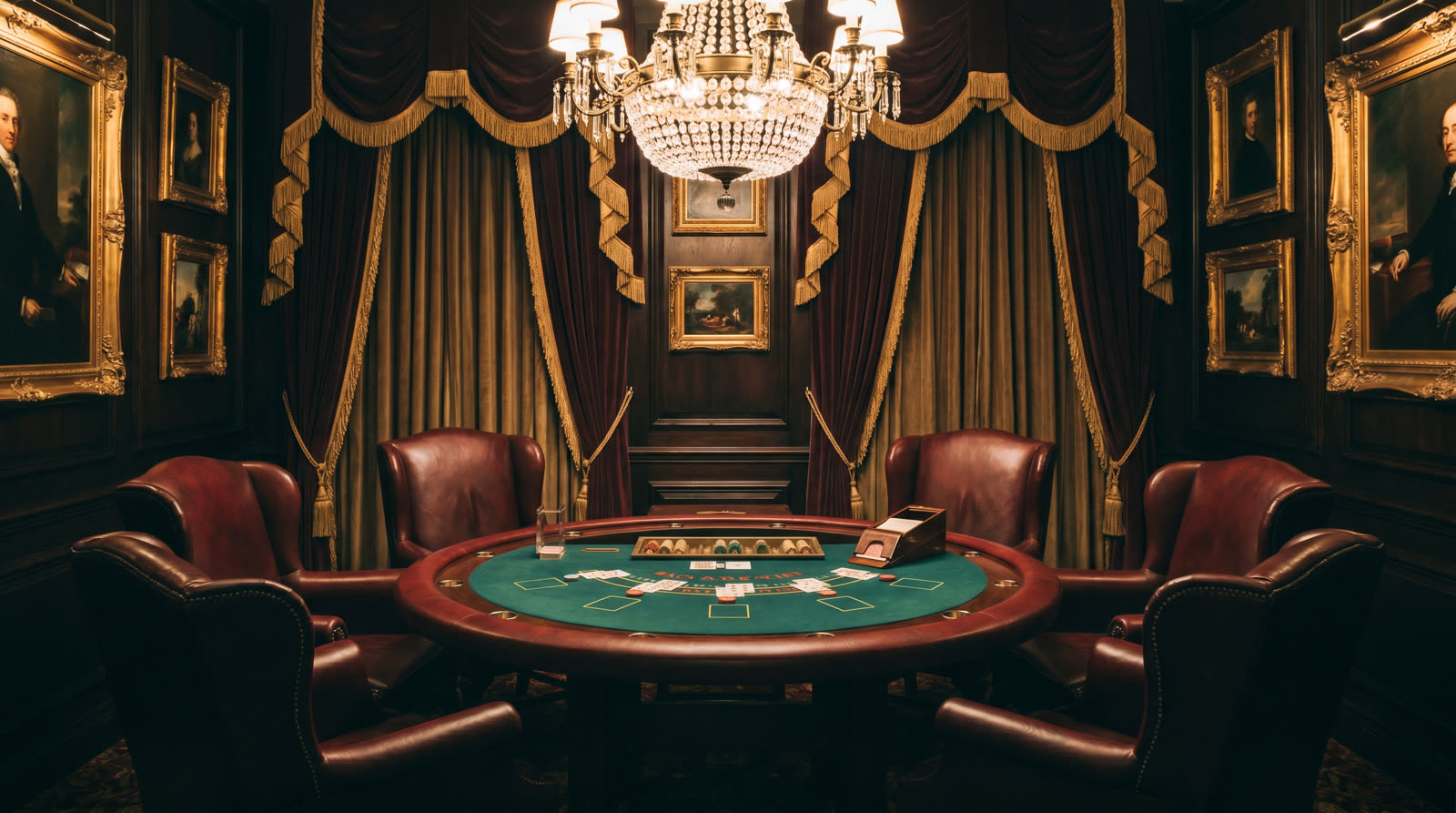
The physical experience is different from a standard table. Fewer players, often two to six. A private or semi-private room with a dedicated dealer and a host who manages the relationship over time. Card squeezing rights given to players on significant hands. More time between hands. Food and drink service at the table.
The physics of the game are unchanged. Banker wins 45.86% of hands. The edge is 1.06%. The third-card tableau applies. None of the ritual accelerates or slows the edge.
The squeeze
The squeeze is the defining ceremony of high-limit baccarat. When a player has placed a large bet on a side, the dealer passes the cards face-down. The player bends the long edges gently, revealing the suit and value incrementally: one pip at a time. A bent corner shows red or black. A further bend shows the number of pips. The corner mark reveals the rank.
The point is anticipation. A natural 9 revealed pip by pip at a table where you've bet HK$1,000,000 is an experience no other casino game offers in that form. The cards cannot be changed by how you look at them. Every player at every high-limit table understands this. The ceremony is about the moment, not the information.
At the Venetian Macao's high-limit rooms, the squeeze is conducted with full ceremony: cards placed face-down on the velvet, the player choosing which to reveal first, other players leaning in, the dealer managing the pace. This is what the Macau DICJ's 88% baccarat revenue figure reflects at a human level: rooms full of this ceremony, at enormous stakes, across hundreds of tables.
At Les Ambassadeurs Club in Mayfair, the squeeze is available in the private baccarat salon. At the Heliot Salon Prive at the Hippodrome, some tables offer it at higher minimums.
I watched a squeeze at the Galaxy Macau that ran for nearly three minutes. The player had HK$500,000 on Banker. He held both cards face down on the felt, circled them once, then began peeling the corner of the first one back one pip at a time. The table was completely silent. The card was a nine. The room made a sound I can only describe as collective relief, even though half the players at the table hadn't bet Banker. The mathematics of that hand were identical to a $25 hand at the Hippodrome. The experience was not.
Superstitions
High-limit baccarat in Asian markets is saturated with superstitions that have no mathematical basis but are culturally embedded.
Blowing on cards before the squeeze. Circling them face-down before looking. Swearing at the cards during a bad reveal and flicking them off the table (some Macau rooms have physical disposal mechanisms for this). Refusing to switch seats during a winning streak. Avoiding specific seat numbers or table positions.
None of these behaviours changes the probability of any outcome. The shoe is shuffled by an automated shuffler, the cards are pre-committed before any player touches them, and the third-card tableau applies mechanically to whatever comes out.
The rituals exist because the stakes are high enough that the emotional experience demands structure. At HK$1,000,000 a hand, the thirty seconds before a card reveal are extremely full of feeling. The ritual fills that time with something that feels meaningful. Not irrational in human terms. Irrelevant in mathematical ones.
The TCS John Huxley Angel Eye shuffler used in many Macau high-limit rooms also scans each card as it's loaded, creating an electronic record that flags if any card is substituted or removed. The ceremony of the squeeze and the mechanical integrity of the shoe coexist in the same room. Both are taken seriously.
Table etiquette: the practical guide
Dress: Les Ambassadeurs effectively means jacket and tie. The Hippodrome Salon Prive requires smart dress. Crown Melbourne's Mahogany Room specifies collared shirts, closed shoes, and no shorts. Macau's VIP rooms vary by operator, but neat business attire is the norm.
Handling cards: take them gently, reveal them slowly, return them to the designated area. Never bend cards sharply enough to mark them. Card damage at this level is taken seriously.
Pace: high-limit rooms run slowly. Don't rush the squeeze, yours or anyone else's. If you're not squeezing the current hand, don't reach for the cards.
Commission settlement: at commission tables, the dealer tracks commission owed throughout the shoe and settles with you at the end. The accounting is accurate. Settle without fuss.
The Phil Ivey context
Phil Ivey's 2012 session at Crockfords (now closed) is the most prominent recent case of a player attempting to gain an edge at a high-limit table. Ivey won approximately £7.7 million by using edge-sorting: asking the dealer to rotate specific cards and then using the resulting asymmetries in the card backs to identify high-value cards before they were dealt. The UK Supreme Court in Ivey v Genting [2017] UKSC 67 ruled that this constituted dishonest conduct under civil law, even though Ivey never touched the shoe in an irregular way. The £7.7 million was never paid.
The case clarifies the legal standard for high-limit players: the casino has the right to protect its legitimate business interest. Players have no legal claim to winnings obtained by techniques that exploit asymmetric information not disclosed to the casino.
Crockfords, which had been on Curzon Street since 1828, closed in November 2023 following a lease dispute with Genting unrelated to the Ivey case. The case remains the most significant legal ruling on advantage play at a UK baccarat table and shapes how high-limit rooms in London approach card handling, dealing requests, and any attempt to condition the game beyond its standard structure. Attending a high-limit room in London today means operating within that legal framework. Les Ambassadeurs and the Hippodrome both maintain the right to refuse service to any player at any time.
Key numbers
| Feature | London high-limit | Macau VIP |
|---|---|---|
| Typical minimum bet | £500 to £5,000 | HK$50,000 to HK$500,000 |
| Players at table | 2 to 8 | 2 to 12 |
| Card squeezing | Often available | Standard |
| House edge on Banker | 1.06% | 1.06% |
| House edge on Player | 1.24% | 1.24% |
Sources: Les Ambassadeurs Club, Venetian Macao casino, Wynn Macau gaming, Crown Melbourne table games, TCS John Huxley, UK Supreme Court Ivey v Genting.
Welcome to the lesson on high-limit baccarat, the squeeze, and table etiquette.
I'm Annabel. This lesson is for those of you who want to understand what baccarat looks like when the ceremony is turned all the way up. The rules don't change at high limits. The edge doesn't change. What changes is everything around the hand.
What makes a high-limit room different from a standard table: in London, minimums from five hundred to five thousand pounds. In Macau's VIP salons, fifty thousand to five hundred thousand Hong Kong dollars per hand. At the very top, private rooms in Macau run hands in the millions of Hong Kong dollars. Fewer players, two to six rather than twelve. A private room. A dedicated host who manages the relationship over time. More time between hands. And the card squeeze.
The squeeze is the central ceremony of high-limit baccarat. When a player has placed a large bet on a side, the dealer passes those cards face-down. The player bends the long edges gently, revealing the suit and value one element at a time. A bent corner shows red or black. A further bend shows the pips. The corner mark reveals the rank. The whole reveal might take thirty seconds. At one hundred thousand dollars a hand, that thirty seconds is extremely full of feeling.
Here is the thing I most need you to understand about the squeeze: the cards cannot be changed by how you look at them. Every player at a high-limit table knows this. The ceremony is about the moment, not the information. A natural nine revealed pip by pip at a table where you've bet a million Hong Kong dollars is an experience no other casino game offers in that form.
I watched a squeeze at the Galaxy Macau that ran nearly three minutes. The player had five hundred thousand Hong Kong dollars on Banker. He circled the cards once on the felt, then began peeling the corner of the first one back one pip at a time. The table was completely silent. The card was a nine. The room exhaled. The mathematics of that hand were identical to a twenty-five pound hand at the Hippodrome. The experience was not comparable to anything else in casino gaming.
At the Venetian Macao's high-limit rooms, the squeeze is conducted with full ceremony: cards placed face-down on the velvet, the player choosing which to reveal first, other players leaning in, the dealer managing the pace. This is what baccarat's eighty-eight percent of Macau's gross gaming revenue looks like at a human level: rooms full of this ceremony, at enormous stakes, scaled across hundreds of tables.
In London, Les Ambassadeurs Club at five Hamilton Place in Mayfair offers the squeeze in the private baccarat salon. The Hippodrome's Heliot Salon Prive has it at higher minimums.
Superstitions. High-limit baccarat in Asian markets is saturated with rituals: blowing on cards before the squeeze, swearing at cards during a bad reveal and flicking them off the table, refusing to switch seats during a winning streak, avoiding specific seat positions associated with bad luck. None of these change the probability of any outcome. The shoe is shuffled by an automated machine. The cards are pre-committed. The third-card tableau applies mechanically to whatever comes out.
The rituals exist because the stakes are high enough that the emotional experience demands structure. The thirty seconds before a card reveal at high stakes needs to be filled with something that feels meaningful. Not irrational in human terms. Irrelevant in mathematical ones.
Some practical etiquette, for those of you who will find yourselves in these rooms.
Dress: Les Ambassadeurs effectively means jacket and tie. The Hippodrome Salon Prive requires smart dress. Crown Melbourne's Mahogany Room specifies collared shirts, closed shoes, and no shorts. The sign outside is not decorative.
Handling cards: take them gently, reveal them slowly. Never bend them sharply enough to mark them. Card damage at this level is taken seriously.
Pace: high-limit rooms run slowly. Don't rush the squeeze, yours or anyone else's.
Commission settlement: at commission tables, the dealer tracks commission owed throughout the shoe and settles with you at the end. The accounting is accurate. Settle without fuss.
One context worth knowing: Phil Ivey won approximately seven point seven million pounds at Crockfords in twenty twelve by using edge-sorting, a technique that exploited asymmetries in the card backs. The UK Supreme Court ruled in twenty seventeen that this constituted dishonest conduct under civil law. The winnings were never paid. The casino has the right to protect its legitimate business interest. That right is legally established.
The mathematics of high-limit baccarat is identical to the Hippodrome's standard table. One point zero six percent on Banker. The chandelier is not a house edge reduction. It's decor.
I asked a pit boss at the Wynn Macau VIP room once whether he ever got used to the stakes. He said: "You don't get used to it. You get professional about it." The ceremony is the same at fifty thousand Hong Kong dollars a hand as at one million. The edge is the same. The commission settles the same way. The room is different. The mathematics is not.
For those of you who will find yourselves in high-limit rooms: know the etiquette before you sit down. Dress correctly. Handle the cards gently. Don't rush someone else's squeeze. Settle your commission without fuss. The rooms operate to a standard. The rooms have a right to enforce it.
Play for the experience if the experience is what you're there for. But know what you're paying for.