
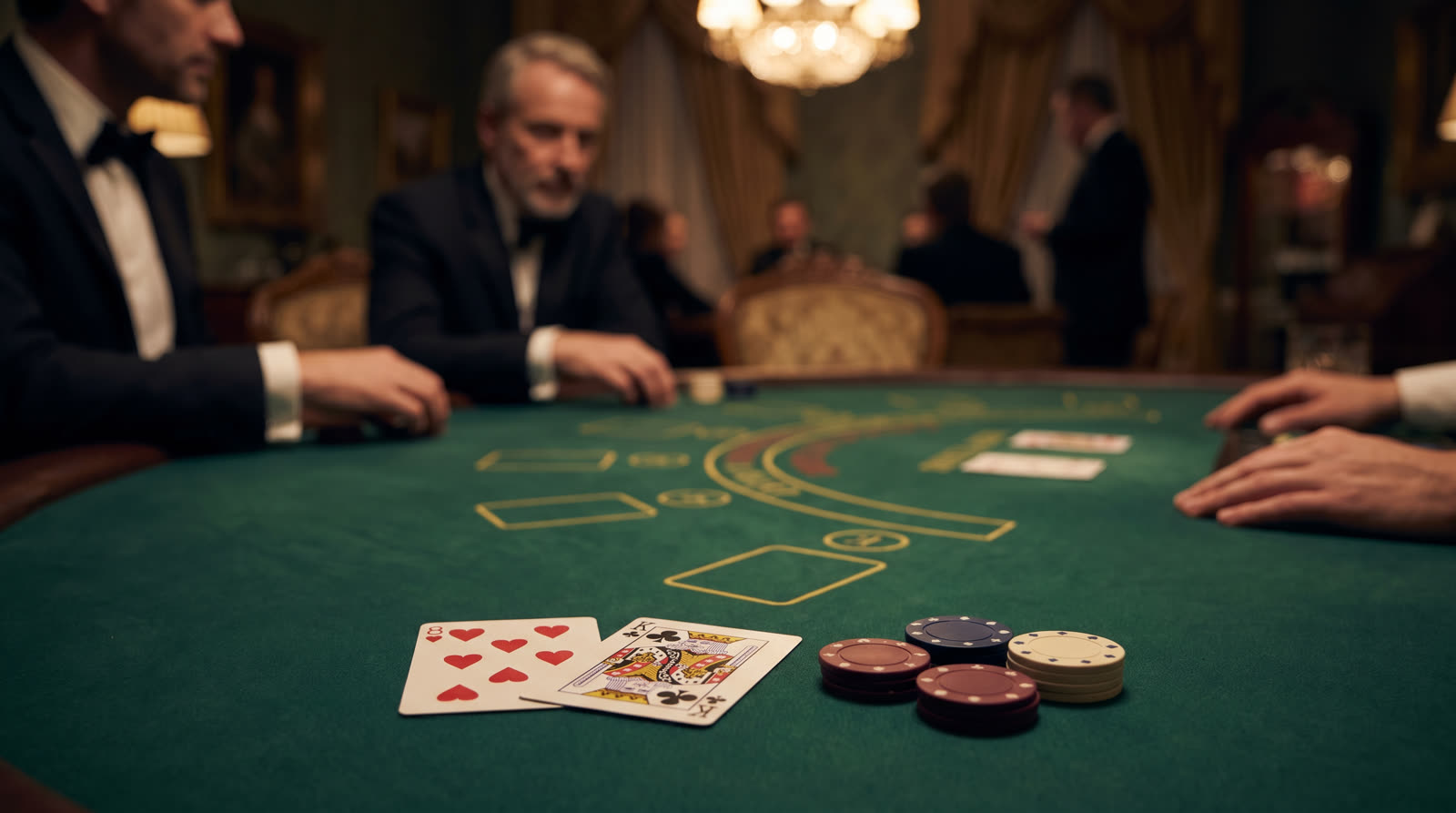
Level 1 · Lesson 2 of 4 · Foundations
How to Play Baccarat: A Walkthrough of a Single Hand

The six steps of a baccarat hand
The single most useful thing a new player can do is hold the sequence of a baccarat hand in mind. Once you can see the six steps, the room stops being intimidating and starts being legible. The croupier is following the same script every hand, and so is everyone else at the table.
Step one: place your bet
Before any cards come out, the dealer calls "place your bets" or, in a London room, "messieurs et mesdames, faites vos jeux". You have three primary options. You can back Player, you can back Banker, or you can back the Tie. The chips go into the boxes in front of you marked accordingly.
Some tables also let you bet a Player Pair, a Banker Pair, or an Either Pair side wager. We'll discuss those in lesson eleven. For your first session, ignore them. The pair side bets carry a 10.36% house edge, which is a deeply unfavourable rate. Banker, Player, or Tie are the three bets that matter.
A dealer at the Hippodrome will give you about ten to twelve seconds to place a bet on a live table. On an electronic terminal it's usually a hard fifteen-second timer with a visible countdown. Once "no more bets" is called, the table is locked.
Step two: the deal
The dealer takes two cards from the shoe and lays them in two pairs on the table, one pair for Player and one pair for Banker. In Punto Banco the dealer turns all four cards face up immediately. In Chemin de Fer the player with the highest Banker stake gets to squeeze and reveal the cards slowly, which is the source of the Macau ritual you may have seen.
The first card always goes to Player. The second to Banker. The third to Player again. The fourth to Banker. Card values are simple: 2 through 9 score face value, picture cards and 10s count zero, aces count one.
Step three: read the totals
Add the two cards on each side. If the total is in double digits, drop the first digit. A seven and an eight is fifteen, which counts as five. A king and a six is six. A nine and an ace is ten, which counts as zero.
This last point trips up new players. A face card on a low card looks like it should be valuable. It isn't. The reason is the modulo-10 scoring system: only the last digit counts. A 6 and a 4 is ten, also zero. The lowest possible score for any hand is zero, the highest is nine.
Step four: check for naturals
If either side has 8 or 9 on the first two cards, it's a "natural". The hand ends immediately. No third card is drawn for anyone. The higher natural wins. If both sides have a natural of the same value, it's a tie.
Naturals are common. About 16% of hands end on a Player natural, 16% on a Banker natural. Roughly one hand in three ends without a third card being drawn at all. That's worth knowing because it shapes how a shoe feels at the table: short, sharp resolutions on natural hands; longer, more theatrical resolutions when the tableau runs.
Step five: run the tableau if required
If neither side has a natural, the punto banco tableau decides whether each side draws a third card. The Player rule is simple. The Banker rule is more involved. We cover both in detail in lesson three, but the headline is: Player draws a third card if Player's two-card total is 0 to 5, and stands on 6 or 7. Banker's decision depends on Player's third card.
You do not need to read the tableau. The dealer does it for you. What you need to know is that there are no decisions to make, and no rules to remember during the hand. The cards turn, the dealer calls the draw, the hand resolves.
Step six: the settle
The higher total wins. Banker bets are paid 19 to 20, which is even money minus the 5% commission. Player bets are paid even money. Tie bets are paid 8 to 1, with Player and Banker bets returned as a push when the result is a tie. The dealer pays out the winning boxes, sweeps the losers, and the shoe moves to the next hand.
The first time I sat at a commission table I was genuinely surprised the 5% wasn't being deducted hand by hand. I watched three Banker wins and no chips moving to any commission box, and spent two minutes wondering if the table was broken.
One note on the Banker commission: it's tracked across the shoe and settled at the end, not deducted hand by hand. The dealer keeps a running tally on the commission rack beside the table. You don't lose 5 cents per pound on each individual Banker win in real time. It accumulates, and when the shoe ends, the dealer calls it. First-time players sometimes assume the 5% comes off each hand and are confused when it doesn't. It comes off at the end.
That's the entire process. Six steps, of which the only one that asks you to do anything is the first.
What it feels like at a real table
I watched a Macau VIP at Wynn squeeze a card for two minutes before he flipped it, and the table held its breath the entire time. At Marina Bay Sands the pace is less ceremonial but the focus is the same: the room goes quiet during the reveal.
A live punto banco table at the Hippodrome runs about 70 to 80 hands per hour. The dealer is professional, calm, and doesn't engage in chit-chat during the hand. Your job, beyond placing the bet, is to keep your hands away from the table, not to touch the cards or the chips once "no more bets" is called, and to settle into the rhythm.
At a Marina Bay Sands baccarat table in Singapore, the rhythm is similar but the table minimums are higher and the atmosphere is more intense. High-limit baccarat there is dealt face down at the big tables, so the bettor with the most money on each side gets to physically turn the cards. That tradition is about ceremony and anticipation, not information. The result is the same either way.
Tipping the dealer ("toke" in the US, "for the dealer" in London) is at your discretion and is normally done by placing a bet on the dealer's behalf, not by handing chips across the table.
Key numbers
| Element | Value |
|---|---|
| Cards in standard shoe | 8 decks, 416 cards |
| Hands per shoe | ~70 to 80 |
| Hands per hour, live table | ~70 |
| Hands per hour, electronic terminal | ~150 to 200 |
| Hands ending on natural | ~32% |
| Banker commission | 5% on Banker wins, settled at shoe end |
| Tie payout | 8 to 1 |
| Pair payout | 11 to 1 |
| Time to act on a live bet | ~10 to 12 seconds |
Sources: Hippodrome Casino baccarat page, Marina Bay Sands casino, UKGC industry statistics.
Welcome to the lesson on how to play baccarat.
I'm Annabel, and in the last lesson we covered what baccarat is. In this lesson we're going to walk through a single hand from start to finish, so the next time you sit at a table you know exactly what's about to happen. There are six steps. Only one of them asks anything of you.
Let's start with the bet, because that's the only step you'll actually act on.
Before any cards come out, the dealer calls "place your bets". In a London room you'll occasionally hear it in French. You have three primary options. You back Player, you back Banker, or you back the Tie. Chips go into the box in front of you marked accordingly. There are also pair side bets at some tables. Ignore them for your first session. They carry a house edge of around ten point three six percent, which is far worse than the main bets. Banker, Player, or Tie are the three bets that matter.
A live table will give you about ten to twelve seconds to act. An electronic terminal will give you a hard fifteen-second timer. Once "no more bets" is called, the table is locked.
Step two is the deal. The dealer takes two cards from the shoe and lays them in two pairs on the table. One pair for Player. One pair for Banker. In Punto Banco, which is what you'll be playing in any modern casino, the dealer turns all four cards face up immediately. The first card goes to Player. The second to Banker. The third to Player. The fourth to Banker.
Card values are simple. Cards two through nine score face value. Picture cards and tens count zero. Aces count one.
Step three is reading the totals. Add the two cards on each side. If the total is in double digits, drop the first digit. A seven and an eight is fifteen, which counts as five. A king and a six is six. A nine and an ace is ten, which counts as zero. This last point trips up new players. A face card on a low card looks like it should be valuable. It isn't. Only the last digit of the sum counts. The lowest possible score is zero. The highest is nine.
Step four is checking for a natural. If either side has an eight or a nine on the first two cards, it's a natural, and the hand ends immediately. No third card is drawn for anyone. The higher natural wins. If both sides have a natural of the same value, it's a tie. About one hand in three ends on a natural, so this isn't a rare event. It shapes the pace of the table.
Step five is the tableau, which runs only if neither side has a natural. The Player rule is straightforward. Player draws a third card if the two-card total is zero to five. Player stands on six or seven. The Banker rule is more involved, and depends on what Player's third card was. We cover the full tableau in lesson three.
Here's the thing I most want you to know. You do not need to memorise the tableau. The dealer reads it for you. The reason baccarat looks intimidating to new players is that the third-card rule looks complicated when you read it on a chart. At the table you'll never have to apply it. The dealer calls the draw and the hand resolves.
Step six is the settle. The higher total wins. Banker wins are paid even money minus a five percent commission. Player wins pay even money straight. Tie pays eight to one, and on a tie the Banker and Player bets are returned as a push. The dealer pays out the winning boxes, sweeps the losers, and the shoe moves to the next hand.
I watched a first-timer at Aspers Stratford stare at the commission box for a full minute after his third Banker win, trying to work out why the dealer hadn't taken anything yet. The dealer explained it at shoe end and the man's relief was audible.
Here's something that surprises first-time players. The five percent commission on Banker wins is not deducted from each hand individually. The dealer keeps a running tally on a commission rack at the side of the table. At the end of the shoe, they call the total and you pay it then. You won't lose five cents per dollar on each Banker win in real time. It accumulates across the shoe and settles at the end.
That's the entire process. Six steps, one decision.
What it actually feels like at a real table is calmer than you might expect. A live punto banco table runs about seventy hands an hour. The dealer is professional and unflappable. Your job, beyond placing the bet, is to keep your hands off the table once "no more bets" is called, settle into the rhythm, and pay attention to the count of your stake.
At a Marina Bay Sands baccarat table in Singapore, the experience is similar but the minimums are higher and the focus is more intense. At the high-limit tables there, the cards are dealt face down and the bettor with the most on each side gets to physically turn them. That ceremony is about anticipation, not information. The result is the same either way.
Know the six steps before you sit down. The dealer does the work. You make one decision and you watch the maths play out.