
Level 1 · Lesson 1 of 4 · Foundations
What Is Baccarat: The Quietest Game in the Room
The game in one paragraph
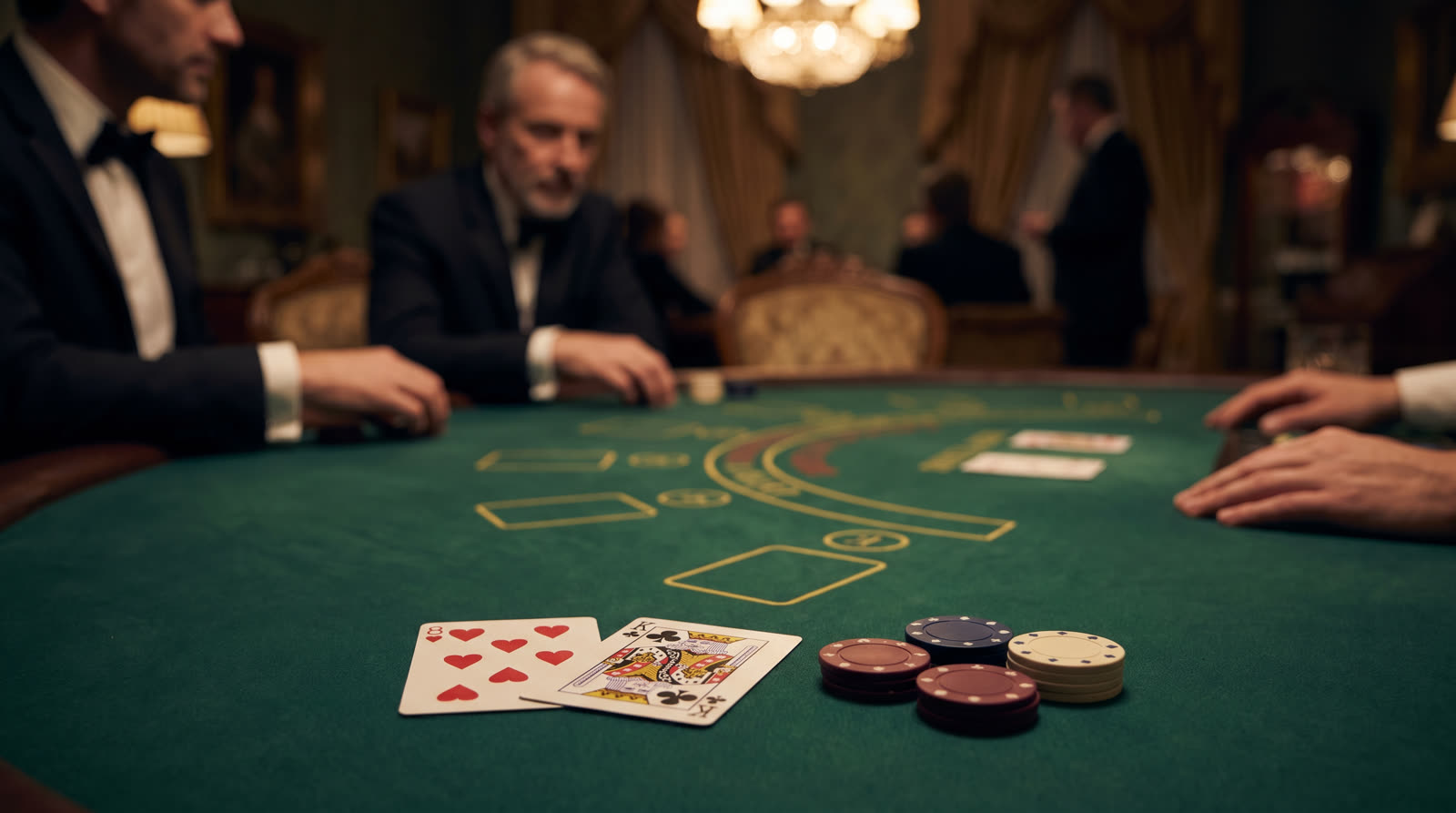
Two hands sit on the table. One is called Player. One is called Banker. They are labels for the two sides of the deal, not for who you are. Before any cards come out, you bet on which hand will end up closer to 9, or you bet on a tie. The dealer turns two cards for each side. Cards 2 through 9 score face value, picture cards and tens count zero, and aces count one. If the total runs into double digits, you drop the first digit: a 7 and an 8 is 15, which scores 5. If either side has an 8 or 9 on the first two cards, that's a "natural" and the hand ends. Otherwise the dealer follows a fixed tableau to decide whether either side draws a third card. Highest total wins. That is the whole game.
Where the game came from, and why it sounds the way it does
The earliest documented version of baccarat is Italian, fifteenth century, possibly French. The French aristocracy adopted it in the nineteenth century and shaped the version most people now play. The word itself, baccara, is the French and Italian word for zero, which is what a face card scores in the game. There are essentially three families that survived into the modern casino.
Chemin de Fer is the original, where players take turns acting as the bank and the casino takes a commission on each shoe. This is the version Ian Fleming wrote into Casino Royale in 1953, and it's the one you'll occasionally find at Les Ambassadeurs Club in Mayfair, or at the Salons Privés at the Casino de Monte-Carlo.
Baccarat Banque is a close relative, also dealer-rotating, played in private rooms in continental Europe. Both are increasingly rare. You're unlikely to encounter either unless you actively seek them out.
Punto Banco is the version invented for high-volume casino play. The casino is always the bank, the rules are fixed, no player makes a decision after the cards come out. This is what every Macau table, every Las Vegas table, every Atlantic City table, and almost every London table runs. When someone says "baccarat" in 2026, they mean Punto Banco.
What baccarat asks of you, and what it doesn't
Most casino card games ask you to make decisions. Blackjack wants you to hit, stand, double, or split. Poker wants you to read the other players. Baccarat asks for a single decision per hand: which side will you back. After that the cards are turned and the tableau runs itself.
This is the source of baccarat's reputation as the high-roller's game. You can wager £200,000 a hand at the Hippodrome's Heliot Salon Privé or at a Macau VIP table without ever having to interpret what the cards mean. The mechanical nature of the drawing rules means that if you understand the basic structure, you understand everything you need to understand. The maths is fixed and the edge is low. You're really betting on which side of a structurally near-symmetrical coin lands face up.
That doesn't mean baccarat is mindless. It means the strategic surface is small, and the only meaningful strategic decision is the one you make before the cards come out. We'll come to bet selection in Lesson 4. The good news is that this lesson is mostly the lesson.
Why the baccarat room is different from the blackjack room
I've sat at the Heliot pit on a Friday night and watched a regular drop forty thousand pounds on Banker over six hours. He never once looked frustrated. That's the game.
Walk into the Hippodrome Casino on a Saturday night and the loud table is blackjack. The quiet one, where the room dims and the dealer wears the suit, is baccarat. The reason isn't ceremony. It's that nothing dramatic happens between the deal and the result. There's nothing to celebrate or curse mid-hand. The cards turn, the totals are read, the bets settle.
At the Wynn Macau VIP rooms the atmosphere is different again. There, players bend and crease the corner of the card slowly to reveal the pips one by one, a ritual known as the squeeze. It takes longer than you'd expect. It changes nothing about the outcome; the cards are already dealt. But the squeeze transforms a fixed probability event into theatre, and at a table where a single hand might represent a year's salary, that theatre has value. The Hippodrome's floor doesn't allow squeezing because the cards are reused. Wynn Macau burns the shoe after every session.
Where you'll find baccarat in London now
I went to Crockfords the week before they shut the doors in November 2023, and the room felt like a wake. The felt was still immaculate, the staff still dressed for a normal Thursday, but everyone knew it was the last shoe.
The London baccarat landscape has thinned in the last few years. Crockfords on Curzon Street, the oldest private gambling club in the world, closed in November 2023 after a lease dispute with Genting. It was the room where the Phil Ivey edge-sorting case played out in 2012, and its closure took the most storied baccarat tables in the city with it. The Ritz Club inside the Ritz Hotel closed in March 2020 and never reopened. The Clermont Club in Berkeley Square closed in 2018.
What's left on the public side is the Hippodrome Casino on Leicester Square, which runs Punto Banco at live tables in the Heliot Salon Privé and on electronic terminals on the main floor. Aspers at Westfield Stratford runs Punto Banco in the high-limit room at weekends. On the members' side, Les Ambassadeurs Club at 5 Hamilton Place still keeps the Mayfair tradition alive with Chemin de Fer. If you want to play baccarat in London in 2026, those are essentially your three addresses.
Key numbers
| Detail | Value |
|---|---|
| House edge, Banker (5% commission) | 1.06% |
| House edge, Player | 1.24% |
| House edge, Tie (8 to 1 payout) | 14.36% |
| Banker win rate | 45.86% |
| Player win rate | 44.62% |
| Tie rate | 9.52% |
| Decks in a standard shoe | 8 |
| Hands per hour, average | 70 to 80 |
| Macau revenue share | ~88% |
Sources: DICJ Macau monthly statistics, UKGC industry statistics, UK Supreme Court, Ivey v Genting [2017] UKSC 67.
Welcome to the lesson on what baccarat actually is.
I'm Annabel, and before we get into systems, edges, side bets, and all the genuinely interesting decisions to come in later lessons, I'd like to spend a few minutes on the game itself. What it is, where it came from, and why a room of people watching cards turn in silence is one of the more compelling things you'll see in any casino.
Let's start with the rules, because the rules are unusually simple.
Baccarat is a comparison game between two hands, called Player and Banker. They're labels for the two sides of the deal. They have nothing to do with you. You don't play as the Player. You don't play as the Banker. You bet on which of those two sides will end up closer to a total of nine, or you bet that they'll tie.
Cards two through nine score face value. Picture cards and tens count zero. Aces count one. If the total runs into double digits you drop the first digit, so a seven and an eight makes fifteen, which scores five. The drawing rules are fixed. There are no decisions to make once the cards come out. You bet, the dealer turns the cards, the tableau runs itself, the highest total wins.
That's the entire game.
Where it came from is roughly four hundred years of European card history. The earliest forms were Italian and French, the aristocracy of nineteenth-century France refined the version most people now play, and the word baccara is the French and Italian word for zero, which is what a face card scores. Three forms survived into the modern casino. Chemin de Fer, where players take turns dealing and the house takes a commission. Baccarat Banque, a continental cousin. And Punto Banco, where the casino is always the bank, the rules are fixed, and the volume is high.
When someone says baccarat in twenty twenty-six, they mean Punto Banco. Every Macau table is Punto Banco. Every Las Vegas table is Punto Banco. Almost every London table is Punto Banco. The other two forms still exist. You'll occasionally see Chemin de Fer at Les Ambassadeurs Club in Mayfair, or at the Casino de Monte-Carlo at the Salons Privés, but you have to go looking for them.
Here's the part that matters for how you play. Most casino card games ask you to make decisions during the hand. Blackjack wants you to hit, stand, double, or split. Poker wants you to interpret the other players. Baccarat asks for a single decision per hand. You back Player, you back Banker, or you back the Tie. After that the cards turn and the maths plays out.
This is why baccarat is the high-roller's game. You can wager two hundred thousand pounds a hand at the Heliot Salon Privé at the Hippodrome on Leicester Square, or at a Macau VIP table, without ever having to interpret what the cards mean. The mechanical nature of the drawing rules means that if you understand the basic structure, you understand everything you need to understand.
That doesn't make baccarat mindless. It means the strategic surface is small, and the only meaningful strategic decision is the one you make before the cards come out.
Here's what you need to know about the three bets.
Banker carries the lowest house edge, at one point zero six percent after the five percent commission. Player is a hair worse at one point two four percent. Tie pays eight to one, but the house edge on Tie is fourteen point three six percent. It's the worst bet on the standard baccarat table by a wide margin.
Here's the thing I most want you to know before you go any further. Baccarat is honest. The edge is small, the rules are fixed, no decision you make during the hand changes the outcome. You're not being outplayed. You're not being tricked. You're playing a shoe with a known structure and a known edge.
In Macau, that honesty is part of why the game dominates the way it does. The Macau gaming regulator reports that baccarat accounts for roughly eighty-eight percent of Macau's gross gaming revenue. The reason isn't cultural mystique, though there is some of that. It's that the game is fast, the edge is low, the limits are very high, and there's nothing about it that rewards bluster.
I asked a dealer at the Casino de Monte-Carlo Salons Privés once how long a squeeze ritual typically ran. She said it depended entirely on the size of the bet. The bigger the bet, the slower the reveal.
I've sat at the Wynn Macau VIP rooms and watched players take twenty minutes to reveal two cards. The squeeze ritual is extraordinary. Players bend and crease the corner of each card to reveal the pips one at a time. It changes nothing about the outcome. The cards are already dealt. But it transforms a fixed probability event into something closer to ceremony. That's a meaningful part of why baccarat holds its place in Asian casino culture, and it's why the Wynn Macau burns every shoe after use rather than reusing cards the way a London public room does.
In London, the same principle applies at smaller stakes. If you happen to be at the Hippodrome on a Saturday, you'll find the loudest table is blackjack and the quietest is baccarat. The reason isn't ceremony. It's that there's nothing dramatic to celebrate or curse mid-hand. The cards turn, the totals are read, the bets settle. You move on to the next hand or you stand up.
That's what we're going to learn to do well across the rest of this course. Choose the right side. Bet what you've decided to bet. Walk when the budget's spent.
Know the game before you bet on it. We'll deal the first hand in the next lesson.