
Level 2 · Lesson 8 of 4 · Know Your Game
Odds, Payouts, and the Honest 1.06%

What house edge means, exactly
House edge is not the probability that you'll lose. It is the average proportion of each wager the casino expects to win over a statistically large sample. On a 1.06% Banker edge, if you place 10,000 bets of $100 each, the casino expects to net approximately $10,600 from your wagering. Individual hands will go either way. The edge asserts itself across many thousands of hands, not across an evening.
This distinction matters because it's misunderstood constantly. Players assume that a 1.06% edge means they'll lose 1.06% of their session. They won't, necessarily. They might win. They might lose 20%. The edge is a long-run statistical average, not a session guarantee.
What you can calculate from it is expected value. If you bet $50 on Banker and the edge is 1.06%, the expected value of that bet is -$0.53. You expect to lose 53 cents. The actual result is either +$47.50 (you win, net of commission) or -$50 (you lose). The expected value sits between those two outcomes, weighted by the probability of each.
Eliot Jacobson's published analysis at apheat.net is the clearest published treatment of how to think about baccarat expected loss, including the distinction between the edge on the initial bet and the element of risk accounting for hands where no commission is collected.
Where the 1.06% comes from
Banker wins 45.86% of hands. Player wins 44.62%. Ties occur 9.52% of the time and are a push: money returned, hand over, for both Banker and Player bets.
On a Banker bet, you collect even money (1 to 1) minus the 5% commission when you win, and you lose your stake when you lose. Ignoring ties:
On a Player bet, you collect even money when you win and lose your stake when you lose. The Tie is a push, not a loss:
This is the honest arithmetic of baccarat, reproduced across Eliot Jacobson's published work at apheat.net and every serious mathematical treatment of the game. The numbers are not contested. The 1.06% on Banker is genuinely close to the theoretical minimum house edge for a table game structured this way.
Comparing baccarat to other games
I've sat at every kind of table in this comparison and I'll tell you which one feels most like a fair deal: it's baccarat at 1.06%. Not because it's exciting. Because the edge is honest.
Baccarat's Banker edge of 1.06% is the second-lowest house edge of any standard casino bet, behind only the pass line bet in craps (1.41%, with full odds bringing it lower) and blackjack with perfect basic strategy (approximately 0.5% under favourable rules).
European roulette carries a 2.70% edge on all outside bets. American roulette (two zeros) runs at 5.26%. Most slot machines in UK casinos run at a return-to-player rate of 90% to 95%, implying a house edge of 5% to 10%. The UK Gambling Commission's industry statistics document gross gaming yield by game category, and baccarat's comparatively lean margins are visible in the data.
The point is not that baccarat is a good bet in the sense of being profitable. It isn't. The point is that baccarat's main bets are among the most honestly structured bets available in a casino. The maths is public, the edges are low, and the rules are fixed.
What the Tie edge means in context
The Tie bet pays 8 to 1 when the two hands finish equal. The probability of a tie on a given hand is 9.52%. For the 8 to 1 payout to be fair (zero edge), ties would need to occur at a rate of 1 in 9, or 11.11%. The gap between 9.52% and 11.11% is the basis of the house edge.
House edge on Tie (8 to 1): 14.36%. This means the casino expects to keep $14.36 of every $100 placed on Tie over a long sequence. A 9 to 1 Tie payout reduces the edge to 4.85%, still five times the Banker edge, and rare in modern London rooms.
The Tie bet is not designed to be broken by insight, luck streaks, or pattern reading. It is structured to return less than it should, and the structure is fixed in the rules.
A word on what happens at Crown Melbourne
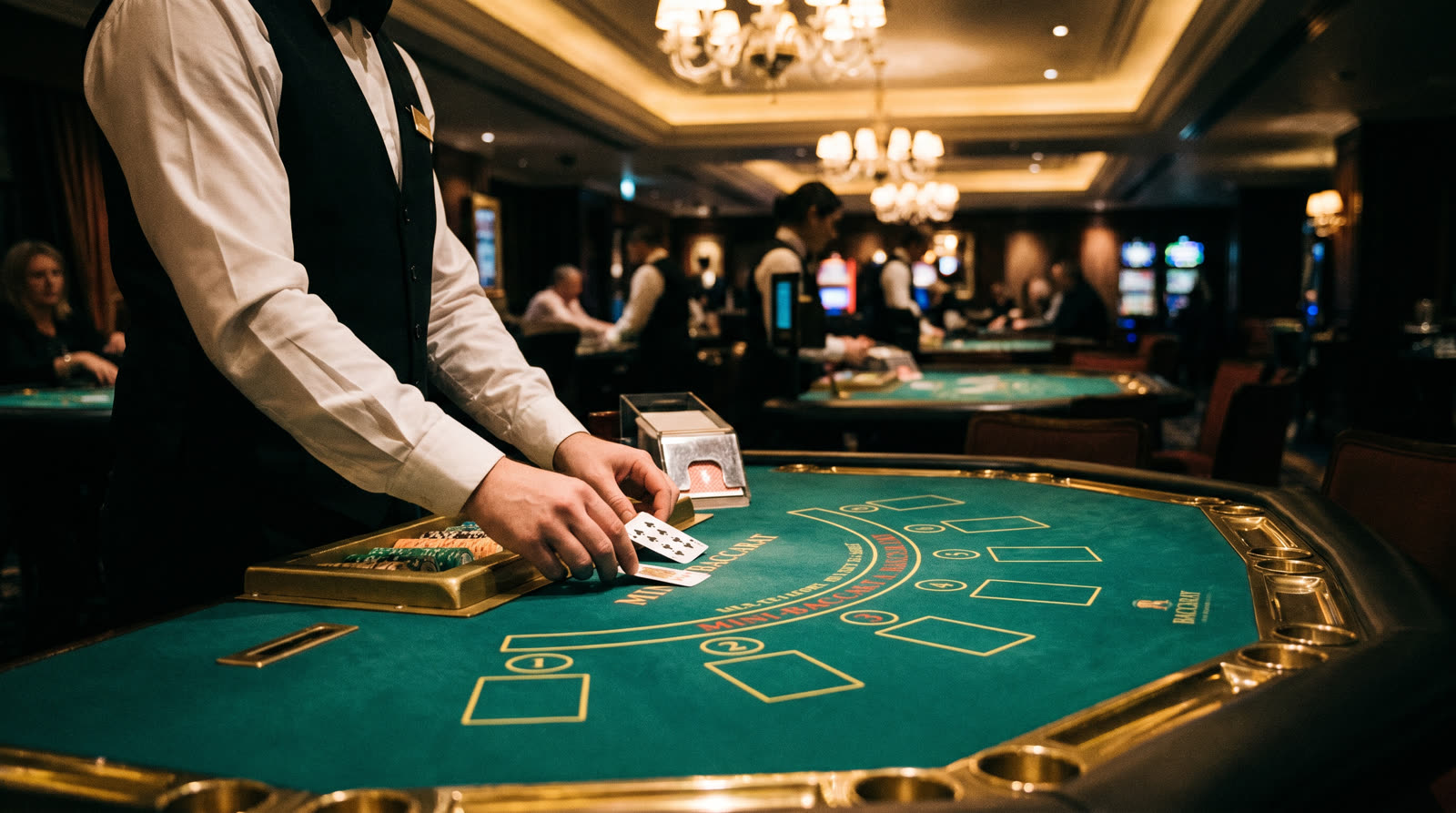
At Crown Melbourne's Mahogany Room, where commission baccarat tables run with minimum bets in the hundreds of dollars, the croupiers will settle commission at the end of each shoe rather than tracking it hand by hand. You'll sometimes hear a player ask the dealer "what's my running commission?" partway through a shoe. The dealer has been tracking it in a small ceramic commission box in front of each player position, one chip per five percent owed. What you're watching is the 1.06% edge making itself visible in physical form. It accumulates, hand by hand, into a real number that you pay at the shoe end. The maths isn't abstract at a live table. It's sitting right in front of you in a commission box.
I watched the commission box at a Les Ambassadeurs table over an hour and a half. The chips in it went up steadily, with the occasional setback on a losing run. By shoe end the player owed roughly three hundred pounds in commission on a session where he'd won overall. That's the edge in its most visible form.
Side bet edges for reference
| Bet | House edge |
|---|---|
| Banker Pair | 10.36% |
| Player Pair | 10.36% |
| Either Pair | 4.86% |
| EZ Dragon 7 | 7.61% |
| EZ Panda 8 | 10.19% |
| Tie (8 to 1) | 14.36% |
None of these bets have a lower edge than the 1.06% Banker main bet. Not one.
Key numbers
| Bet | Win probability | Payout | House edge | Expected loss per $100 |
|---|---|---|---|---|
| Banker (5% commission) | 45.86% | 19 to 20 | 1.06% | $1.06 |
| Player | 44.62% | 1 to 1 | 1.24% | $1.24 |
| Tie (8 to 1) | 9.52% | 8 to 1 | 14.36% | $14.36 |
| Tie (9 to 1) | 9.52% | 9 to 1 | 4.85% | $4.85 |
| No Commission Banker | 45.86% | 1 to 1 (1 to 2 on 6) | 1.46% | $1.46 |
Sources: Eliot Jacobson, element of risk in baccarat, UKGC industry statistics, Crown Melbourne gaming, Evolution Gaming baccarat.
Welcome to the lesson on odds, payouts, and the honest one point zero six percent.
I'm Annabel, and this lesson is the maths lesson. It's not complicated maths. But I want to give you a clear, unambiguous account of what the house edge actually means, where the numbers come from, and why baccarat's edges are worth understanding precisely.
Let me start with what house edge actually means.
House edge is not the probability that you'll lose. It is the average proportion of each wager the casino expects to win over a large number of hands. On a one point zero six percent Banker edge, if you place ten thousand bets of one hundred dollars each, the casino expects to net roughly ten thousand six hundred dollars from your wagering. Individual hands go either way. You might win your session. You might lose significantly more than one point zero six percent. The edge asserts itself across many thousands of hands, not across an evening.
What you can calculate from it is expected value. If you bet fifty dollars on Banker, the expected value of that bet is negative fifty-three cents. You expect to lose fifty-three cents. The actual result is either positive forty-seven fifty (you win, after commission) or negative fifty dollars (you lose). The expected value sits between those two outcomes, weighted by probability.
Now, where the numbers come from.
Banker wins forty-five point eight six percent of hands. Player wins forty-four point six two percent. Ties happen nine point five two percent of the time and are a push: money returned, hand over.
On a Banker bet, you collect even money minus the five percent commission when you win. Expected return per unit: forty-five point eight six percent multiplied by zero point nine five, minus forty-four point six two percent, equals approximately negative one point zero six percent. That's the one point zero six percent house edge on Banker. It's arithmetic.
On a Player bet, you collect even money when you win and lose your stake when you lose. Expected return: forty-four point six two percent minus forty-five point eight six percent, equals approximately negative one point two four percent. The one point two four percent Player edge.
The Tie. Pays eight to one when both hands finish equal. The probability of a tie on any given hand is nine point five two percent. For an eight-to-one payout to be a fair bet, you'd need ties to happen at eleven point one one percent. The gap between nine point five two and eleven point one one is the basis of the house edge on Tie: fourteen point three six percent.
Here is the thing I most need you to know about that number. Fourteen point three six percent on the Tie bet means the casino expects to keep fourteen dollars thirty-six of every one hundred dollars placed on it over a long sequence. That is not a long-shot reward. That is a structural overcharge built into the payout schedule. You can't read your way out of it. You can't pattern-spot your way out of it. The fourteen point three six percent is fixed.
Compare those numbers to the rest of the casino.
European roulette carries two point seven zero percent on all outside bets. American roulette runs at five point two six percent. Slot machines in UK casinos typically run at five to ten percent. Blackjack with perfect basic strategy can reach approximately zero point five percent under favourable rules, which is better than Banker, but requires memorising a strategy chart and playing conditions most land-based rooms don't offer.
Baccarat's Banker bet at one point zero six percent is among the most honestly structured bets in a casino. The maths is public, the rules are fixed, and the edge is low.
Side bets are different. Banker Pair and Player Pair each carry an edge of ten point three six percent. Either Pair is four point eight six percent. EZ Baccarat's Dragon Seven side bet runs at approximately seven point six one percent. The Tie at fourteen point three six is the worst of the regular options.
Not one of those side bets has a lower edge than the one point zero six percent Banker main bet. Not one.
I watched a regular at Aspers Stratford do exactly this for an entire shoe: flat Banker on the main bet, Pair side bet every hand. By shoe end his main game had come out roughly even. His pair bets had cost him more than ninety pounds. He'd paid twice for the same seat.
I've watched it happen at Crown Melbourne's Mahogany Room: a player sitting at a hundred-dollar minimum table, betting Banker correctly on the main game, then placing a ten-dollar Banker Pair side bet every single hand out of habit. The main game was fine at one point zero six percent. The side bet was running at ten point three six percent and costing far more per hour than the main game ever would. The house edge is always there. The question is which version of it you're paying.
Know these numbers. One point zero six, one point two four, fourteen point three six. They are the game. Everything else in baccarat strategy is embroidery on those three numbers or an attempt to obscure them.
The maths isn't trying to hide from you. Make sure you're not hiding from the maths.