
Level 2 · Lesson 7 of 4 · Know Your Game
The Baccarat Variants You'll Encounter and Why Most Don't Matter

Punto Banco: the default
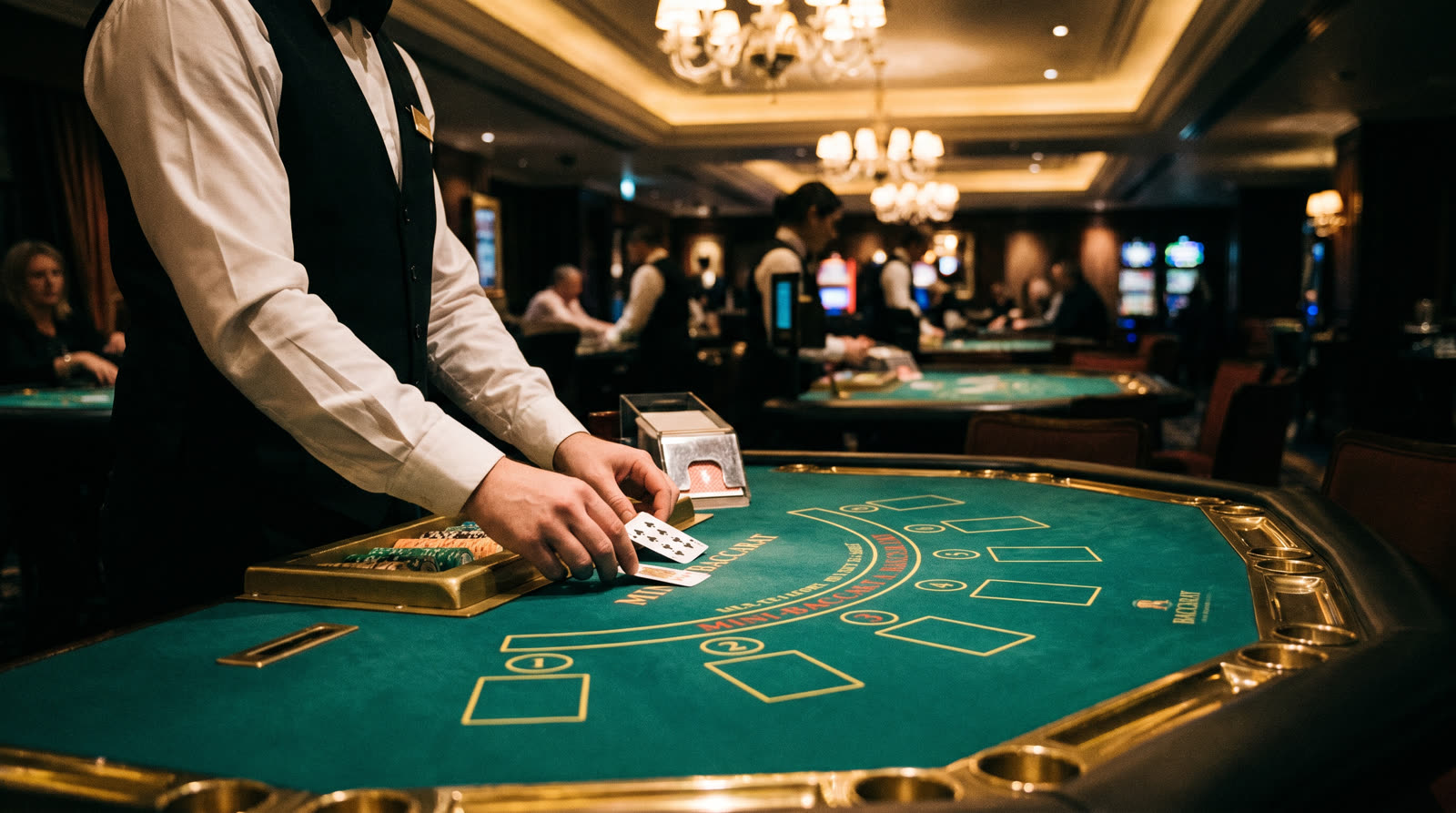
Every lesson in this school assumes Punto Banco unless stated otherwise. It is the version at every major casino in Macau, Las Vegas, Singapore, and London. It is the version offered by every major live dealer provider online. The casino is always the bank. The rules are fixed and predetermined. Players make no decisions once the cards come out.
In London, the Hippodrome's Heliot Salon Prive runs Punto Banco. The baccarat rooms at Marina Bay Sands in Singapore run Punto Banco. The Wynn Macau salons run Punto Banco. When casino revenue statistics from the Macau Gaming Inspection and Coordination Bureau show baccarat generating roughly 88% of Macau's gross gaming revenue, they mean Punto Banco: the format that allowed extremely high table limits and fast dealing without requiring skilled players.
The house edges are the bedrock of this school: 1.06% on Banker, 1.24% on Player, 14.36% on Tie. These numbers are fixed in the rules of the game and confirmed by every mathematical treatment of the standard eight-deck shoe format.
EZ Baccarat
EZ Baccarat was developed by DEQ Systems Corp. and introduced to casinos in 2004. The defining change is simple: no commission on Banker wins. Instead, if Banker wins with a three-card total of 7, the hand is declared a push (a tie), and Banker bets are returned without profit.
The three-card Banker-seven result is called the Dragon 7. It occurs on about 2.25% of hands. By neutralising this specific result rather than charging a commission, the casino achieves a similar hold to the commission model, with slightly different maths.
The house edge on EZ Baccarat Banker is 1.02%, which is actually marginally better for the player than the standard 1.06% commission Banker. The Player bet remains at 1.24%.
The catch is that EZ Baccarat tables almost universally offer two side bets designed to recapture casino margin: Dragon 7, which pays 40 to 1 when Banker wins with a three-card 7 and carries a house edge of approximately 7.61%, and Panda 8, which pays 25 to 1 when Player wins with a three-card 8 and carries a house edge of approximately 10.19%. These side bets exist to ensure that the no-commission format is not simply a 1.02% edge gift to players.
If you sit at an EZ Baccarat table and ignore both side bets entirely, you're playing at a 1.02% Banker edge. That's a hair better than standard. Most players don't ignore the side bets, which is precisely why the format was designed this way. Galaxy Gaming, the company that licences Dragon 7 and Panda 8 to casino operators, generates revenue from exactly this mechanism.
No Commission Baccarat (Super 6)
No Commission Baccarat, often branded Super 6, modifies the Banker payout rather than introducing a push rule. Banker wins pay even money in all cases except when Banker wins with a total of 6, which pays 1 to 2 instead of 1 to 1. You win half your stake on a Banker-six result rather than doubling your stake.
Banker wins with 6 occur on roughly 5.39% of hands. The reduced payout on these results costs the player more than the commission saving elsewhere. The house edge on No Commission Banker is 1.46%, compared to 1.06% on standard commission Banker.
In plain terms: Super 6 is a worse deal for the player than standard baccarat, despite marketing itself as the game without a commission. The absence of commission paperwork at the table is convenient for both casino and player in a fast-paced game. The price of that convenience is a higher house edge.
If you encounter a Super 6 table as your only option, play it. But don't prefer it. The maths runs against you by an additional 0.40 percentage points relative to standard Banker.
Chemin de Fer and Baccarat Banque
Chemin de Fer is the original form of the game, documented in French casinos from the late nineteenth century, and the variant Ian Fleming used in Casino Royale in 1953. The name means "iron road" or "railway" in French, a reference to the card shoe sliding around the table.
Players take turns acting as the bank. The player holding the bank role puts up a stake; other players bet against the bank in turn. The player-bank can make limited decisions: whether to draw a third card when holding a total of 5 on the Player hand. The casino takes a commission on each hand rather than taking a structural edge from the cards.
Chemin de Fer is alive at Les Ambassadeurs Club in Mayfair and at the Salons Prives at the Casino de Monte-Carlo. It is not what you'll find at any mainstream London or Macau room, and it requires a familiarity with the optional drawing rules that standard Punto Banco players don't need.
I sat at the Chemin de Fer table at Les Ambassadeurs on a Thursday evening once, late enough that the floor was quiet. Four players, unhurried, the dealer managing the pace with the confidence of someone who'd been doing it for twenty years. Nothing in any Macau room has that quality.
On the baccarat floors of Crown Melbourne's Mahogany Room, you won't see Chemin de Fer either. The format has retreated to a handful of prestige rooms in Europe where the ritual of player-dealing remains part of the product. Most venues globally standardised on Punto Banco decades ago.
Baccarat Banque is similar: the bank remains with one player for the duration of a shoe rather than rotating. Found in a handful of continental European casinos. Both are specialist formats for experienced players in specialist rooms.
Dragon Tiger
Dragon Tiger is not baccarat. It is a two-card comparison game, often placed in the baccarat pit in Macau and Asian casino markets, in which one card is dealt to Dragon and one to Tiger, and the higher card wins. The rules are completely different. The house edge on the Dragon or Tiger bet is approximately 3.73%, compared to baccarat's 1.06%.
If you sit down at what you think is a baccarat table and the layout says Dragon and Tiger rather than Banker and Player, you're in the wrong game. The experience looks similar from a distance. It isn't baccarat.
I've seen this happen at the Venetian Macao: a tourist settled in, placed a serious bet on what he thought was Banker, and won. He was at a Dragon Tiger table. He'd backed Dragon. He didn't realise until the dealer explained the payout.
A note on casino-floor labelling
One practical complication: not every casino uses precise variant names on its table signage. In Macau VIP rooms, the game is simply "baccarat," and the format is invariably Punto Banco. In some US casinos, "EZ Baccarat" will be marked on the layout, but the label is sometimes omitted at online tables where the variant is assumed. If you see "Super 6" or "No Commission" on the felt, that confirms the 1.46% format. If there is no label and you're online, check the game information panel for the Banker commission rate.
Key numbers
| Variant | Banker edge | Player edge | Notes |
|---|---|---|---|
| Punto Banco (standard) | 1.06% | 1.24% | Default game everywhere |
| EZ Baccarat | 1.02% | 1.24% | Dragon 7 is a push, not a win |
| No Commission (Super 6) | 1.46% | 1.24% | Banker-six pays 1 to 2 |
| Chemin de Fer | Variable | Variable | Player-bank decisions involved |
| Dragon Tiger | 3.73% (Dragon/Tiger) | N/A | Not baccarat; different game |
Sources: Hippodrome Casino baccarat, Marina Bay Sands table games, Casino de Monte-Carlo, Macau DICJ gaming statistics 2023, Galaxy Gaming product catalogue, Britannica on Casino Royale.
Welcome to the lesson on baccarat variants.
I'm Annabel, and this lesson is partly a map and partly a warning. There are a lot of things with "baccarat" in the name in a modern casino. Most of them are either the same game with minor rule tweaks, or something entirely different that happens to sit in the baccarat pit. I'll tell you what's what.
Let's start with the only one that really matters.
Punto Banco is the standard game. It's what every major casino in Macau, Las Vegas, Singapore, and London runs. The casino is always the bank. The rules are fixed. Players make no decisions once the cards come out. If someone says "baccarat" without qualification, they mean Punto Banco. House edge: one point zero six percent on Banker, one point two four on Player, fourteen point three six on Tie. That's the game.
EZ Baccarat. Developed in two thousand and four. The defining change: no commission on Banker wins. Instead, when Banker wins with a three-card total of seven, the hand is declared a push. Banker bets are returned without profit. That specific result is called the Dragon Seven. It happens on about two point two five percent of hands.
The result of this change is that the house edge on EZ Baccarat Banker is one point zero two percent, fractionally better than standard Banker at one point zero six. Player stays at one point two four.
But EZ Baccarat tables almost universally offer two side bets that exist to recapture what the casino gave away. Dragon Seven pays forty to one when Banker wins with a three-card seven. House edge: approximately seven point six one percent. Panda Eight pays twenty-five to one when Player wins with a three-card eight. House edge: approximately ten point one nine percent. Galaxy Gaming licences both side bets to casino operators precisely because they restore margin the no-commission rule otherwise forgoes.
The main bet on EZ Baccarat is marginally good for you. The side bets are there to make sure you don't take full advantage of that.
No Commission Baccarat, often called Super Six. Banker wins pay even money in all cases except one: when Banker wins with a total of six, the payout drops to one to two. You win half your stake on a Banker-six result instead of doubling your stake. Banker wins with six happen on roughly five point three nine percent of hands. The reduced payout on those results costs more than the commission saving. House edge on No Commission Banker: one point four six percent. That's worse than standard Banker at one point zero six percent by zero point four percentage points.
Super Six removes the commission paperwork from the table, which is genuinely convenient. The price of that convenience is a higher house edge. If it's your only option, play it. Don't seek it out.
Chemin de Fer. This is the original form of the game, from nineteenth-century French casinos. Players take turns acting as the bank. The player-bank can make limited decisions: whether to draw on a total of five. The casino takes a commission on each shoe rather than a structural edge from the cards. Ian Fleming used this version in Casino Royale in nineteen fifty-three.
Here is the part most histories leave out: Chemin de Fer didn't disappear. You'll find it at Les Ambassadeurs Club in Mayfair and at the Salons Prives at the Casino de Monte-Carlo. The rituals of player-dealing and card passing are still intact in those rooms. You won't find it at the Hippodrome or at any mainstream room in Macau. It requires understanding the optional drawing rules, which is a different level of complexity from Punto Banco.
I visited the Chemin de Fer table at Les Ambassadeurs once at eleven on a Thursday evening. The players were not particularly young, the dealing was unhurried, and there was a quality of ceremony about it that the standard rooms don't have. It's worth experiencing, once, if you're in the area and the dress code doesn't put you off.
At the Casino de Monte-Carlo Salons Privés the same format runs with an even more deliberate pace. The room expects you to know what you're doing before you sit down.
Baccarat Banque is similar to Chemin de Fer: the bank stays with one player for the entire shoe rather than rotating. Found in continental Europe. Both are specialist formats for specialist rooms.
Dragon Tiger. This is the one you really need to know about. Dragon Tiger is not baccarat. It's a two-card comparison game: one card to Dragon, one to Tiger, higher card wins. Different rules, different game, sometimes parked in the baccarat pit in Macau and Asian markets because the table layouts look similar from a distance. The house edge on Dragon or Tiger is approximately three point seven three percent, not one point zero six. If you sit at a table and the layout says Dragon and Tiger instead of Banker and Player, you're in the wrong game.
So: Punto Banco is the standard. EZ Baccarat is marginally better on the main bet but aggressively side-bet around. Super Six is worse than standard and exists to avoid commission paperwork. Chemin de Fer is the historical original, found in private rooms at Les Ambassadeurs and Monte-Carlo. Dragon Tiger is something else entirely.
Learn the standard game. Everything else will make more sense once you know what it's varying from.